55 Plus Community vs Retirement Home
A 55 plus community is a neighbourhood of privately owned homes for independent active adults, while a retirement home is a licensed rental residence providing daily care services such as meals and medication support. Understand the differences in independence, ownership, costs, and care levels to choose the right option.
Start Your Home Evaluation Download Comparison Guide (PDF)View All Ontario 55+ Community Listings
Looking for comparable properties or want to see what is currently on the market? Our interactive map shows ALL current MLS listings in adult lifestyle communities across Ontario, updated daily.
Explore Ontario 55+ CommunitiesYour 55 Plus Community vs Retirement Home Guide Map
Jump to any section below:
Common Questions About 55 Plus Communities vs Retirement Homes
What is the difference between a retirement home and a 55 plus community?
A 55 plus community is an age-restricted neighbourhood where independent adults buy or lease a private home, maintaining full independence with no on-site care. A retirement home is a privately paid rental facility that provides a suite or room along with daily care services such as meals, housekeeping, and medication administration.
Is a 55 plus community the same as a retirement home?
No. While the terms are often confused, they are entirely different living arrangements. A 55 plus community focuses on an active, independent lifestyle and homeownership. A retirement home focuses on providing support and care services in a staffed, rental environment.
Do 55 plus communities provide medical care?
No. 55 plus communities are designed for healthy, active adults and do not provide on-site medical care, assisted living services, or nursing staff. If you need medical assistance while living in a 55 plus community, you must arrange for private home care or publicly funded services through Ontario Health atHome.
Which is cheaper, a 55 plus community or a retirement home?
It depends on how you measure cost. A 55 plus community requires a significant upfront purchase price (typically $200,000 to over $1.2 million) but builds equity. A retirement home requires no purchase but charges a high monthly rent (typically $3,000 to $6,500+) which covers accommodation, meals, and care, but builds no equity.
What is the difference between a retirement home and long term care in Ontario?
A retirement home is a private-pay rental residence for seniors who need some daily support but can direct their own care. Long term care (nursing homes) provides 24-hour nursing and personal care, is subsidized by the Ontario government, and is reserved for individuals whose needs cannot be safely met in the community.
When planning for the next stage of life, the terminology can be confusing. Many people use "retirement community" as a catch-all phrase, but in Ontario, there is a massive legal, financial, and lifestyle difference between moving to a 55 plus community and moving into a retirement home. Understanding this distinction is the first and most important step in your downsizing journey.
A 55 plus community (often called an active adult or adult lifestyle community) is essentially a specialized residential subdivision. You purchase a detached bungalow, townhouse, or condo in a neighbourhood designed for independent adults. These communities offer shared amenities like clubhouses, pools, and golf courses, and they typically handle exterior maintenance like snow removal. However, you are entirely responsible for your own meals, housekeeping, and personal care. You are buying real estate and preserving your equity.
A retirement home (or seniors residence) is a privately paid rental facility licensed by the Retirement Homes Regulatory Authority (RHRA). You do not buy the property; you pay a monthly rent that covers your suite, meals in a communal dining room, housekeeping, and access to care services like medication administration or bathing assistance. Retirement homes are designed for seniors who need a supportive environment to manage their daily activities safely.
Kevin's Experience with Downsizers
Over my 38 years in real estate, since 1988, I've seen many clients start their search looking for a "retirement home" when what they really wanted was a 55 plus community. They were healthy, active, and wanted to preserve the equity from the sale of their family home, but they were tired of shoveling snow and maintaining a large property. Once we clarified that a 55 plus community allows them to own their home and maintain their independence while shedding the heavy maintenance, the path forward became clear. My goal is to ensure you understand these options before you sell your current house.
Detailed Comparison: 55+ Community vs Retirement Home
Compare the key features of both options to determine which living arrangement aligns with your current needs and financial goals.
| Feature | 55 Plus Community (Active Adult) | Retirement Home (Seniors Residence) |
|---|---|---|
| Target Resident | Independent, active adults seeking a low-maintenance lifestyle with peers. | Seniors who require some daily support, meals, or care services to live safely. |
| Ownership & Equity | You own the home (or lease the land). Builds equity and remains an estate asset. | Monthly rental model. No ownership, no equity built. |
| Accommodation Type | Detached bungalows, townhouses, or condo apartments with full kitchens. | Private suites, studios, or 1-bedroom units, typically with a kitchenette only. |
| Care Services | None provided. Residents must arrange private or publicly funded home care if needed. | Must provide at least two care services (e.g., meals, medication administration, bathing). |
| Meals & Dining | Residents cook their own meals in their own full kitchens. | Meal plans included; dining is typically communal in a central dining room. |
| Typical Age Range | Usually 55 to 75+ upon entry. | Usually 75 to 85+ upon entry. |
| Regulation | Governed by Condo Act, Residential Tenancies Act (land lease), or local bylaws. | Regulated by the Retirement Homes Act, 2010 and licensed by the RHRA. |
Understanding Ownership and Equity
The most significant financial difference between a 55 plus community and a retirement home is how your money is treated: as an investment or as an expense.
- Equity Preservation in 55 Plus Communities
- When you buy into a 55 plus community, you are purchasing real estate. Whether you choose a freehold, condominium, or land lease model, you own a physical asset. If the property appreciates, your estate benefits. This allows you to park the equity from the sale of your family home securely while enjoying your retirement.
- The Rental Model of Retirement Homes
- Retirement homes operate strictly on a rental model. You sign a lease and pay a monthly fee that covers your suite and services. While this requires no large upfront capital investment (beyond a potential move-in fee), the monthly costs are substantial, and none of that money builds equity or can be passed on to your heirs.
- Life Lease as a Middle Ground
- Some life lease communities blur the lines. You purchase the right to occupy a unit for life, often from a non-profit sponsor. While not true freehold ownership, you typically recover the market value of the unit (minus administrative fees) when you leave, offering a form of equity preservation.
For a deeper dive into how different property types affect your investment, read our guide on Condo vs 55 Plus Community.
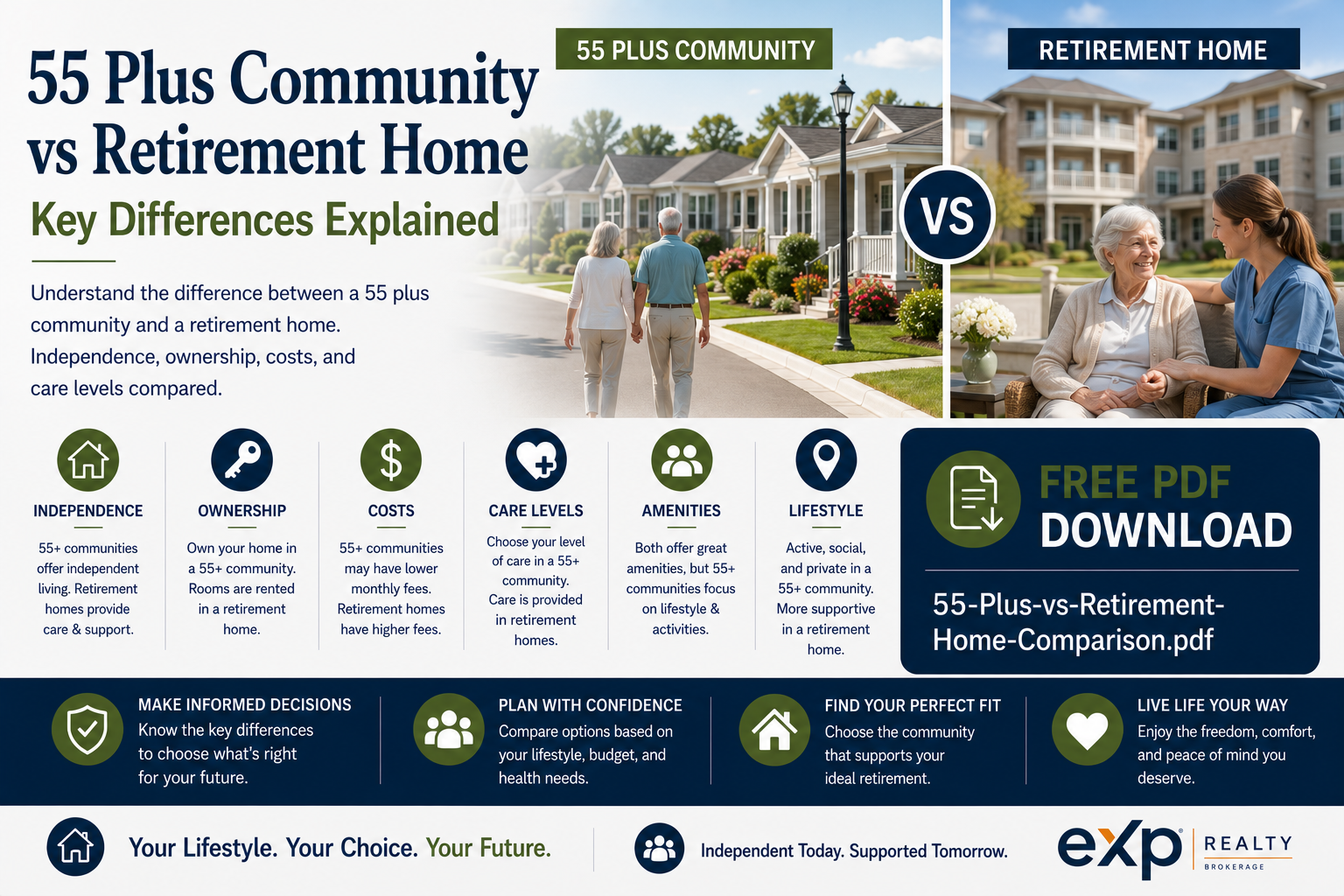
Click the image above to download your free 55 Plus vs Retirement Home Comparison Guide (PDF).
Comparing Costs: Capital vs Cash Flow
Budgeting for these two options requires entirely different financial planning. One requires significant capital upfront with lower ongoing costs, while the other requires high monthly cash flow.
- Costs in a 55 Plus CommunityYou will face an upfront purchase price typically ranging from $200,000 for an affordable land lease home to over $1.2 million for a luxury freehold bungalow. Ongoing costs include property taxes, utilities, and either condo fees ($300 to $800/month) or land lease lot fees ($500 to $1,200/month). You also pay for your own food and household expenses. Learn more about the cost of 55 plus communities in Ontario.
- Costs in a Retirement HomeThere is no purchase price, though a one-time move-in fee of $1,000 to $5,000 is common. The primary cost is the monthly rent, which according to recent estimates, averages between $3,000 and $6,500+ in Ontario, depending on the location and level of care required. Specialized memory care or assisted living floors can exceed $8,000 per month. This fee generally includes your accommodation, utilities, three meals a day, housekeeping, and basic care services.
- The Long-Term ImpactLiving in a retirement home at $5,000 per month consumes $60,000 of your savings annually. In contrast, a paid-off freehold home in a 55 plus community might only cost $8,000 annually in taxes and maintenance, preserving your capital for travel, hobbies, or your estate.
Care and Medical Services
The level of care you need is the most critical deciding factor between these two options. It is essential to be realistic about your current health and future requirements.
The Independent Lifestyle
55 plus communities are built for independence. They provide lifestyle amenities like golf courses, tennis courts, and social clubs, but they do not employ medical staff or personal support workers. If you live in an active adult community and experience a health decline, you must arrange for private home care or qualify for publicly funded services through Ontario Health atHome, just as you would in a traditional suburban house.
The Supportive Environment
Retirement homes are designed to provide support. Under the Retirement Homes Act, a licensed facility must offer at least two of thirteen specific care services. These typically include assistance with feeding, bathing, personal hygiene, dressing, dementia care, and the administration of medication. They also feature emergency call systems in suites and 24-hour staff on-site to respond to falls or medical emergencies. This makes them the safer choice for seniors who are becoming frail or experiencing cognitive decline.
How to Choose the Right Option
Making the right choice depends on a candid assessment of your health, your finances, and your desire for independence.
- Assess Your Daily NeedsIf you can comfortably cook your own meals, manage your medications, and handle personal hygiene without assistance, a 55 plus community offers the most freedom and the best financial return. If you struggle with these daily tasks, a retirement home provides necessary safety and support.
- Evaluate Your FinancesReview the equity in your current home. If selling it provides enough capital to buy a home in a 55 plus community outright, you can secure a very low monthly cost of living. If you prefer to invest that capital elsewhere and use the returns to pay monthly rent, a retirement home model might align with your strategy.
- Consider the Transition PathMany seniors use a two-step approach. They sell the large family home in their 60s or 70s and move to a 55 plus community to enjoy an active, low-maintenance retirement. Years later, in their 80s, if their health requires it, they sell that property and use the equity to fund a move into a retirement home or long-term care facility.
For a complete step-by-step guide to making this transition, read our Downsizing to a 55 Plus Community Checklist.
Selling Your Current Home to Fund Your Next Chapter
Whether you are buying into a 55 plus community or using the proceeds to fund years of rent in a retirement home, the sale of your existing house is the financial engine that powers your retirement. Maximizing the equity in your current home gives you the freedom to choose the community and lifestyle you truly want, rather than settling for what you can afford.
The sequence of selling and buying is critical. If you are moving to a 55 plus community, you need to coordinate closing dates carefully to avoid carrying two properties or needing bridge financing. If you are moving to a retirement home, you may choose to move first, allowing your Realtor to stage and sell your empty house for top dollar without disrupting your daily routine.
Kevin Flaherty has spent over 38 years, since 1988, helping south-central Ontario homeowners navigate this exact transition, with more than $500M sold. His marketing system, built around Video Narrated VR Animated Online Showings, presents your home to buyers across the province before they ever book a visit. This means the showings you do host are with serious, pre-qualified buyers, minimizing the stress and disruption of selling. Read the step-by-step process in our guide to selling your home to buy into a 55 plus community, or start with a free home evaluation.
Not Sure What Your Current Home Is Worth?
Before you tour a single 55 plus community or retirement home, find out exactly how much buying power your current home gives you. Kevin provides free, no-obligation evaluations with no pressure and no strings attached.
Start Your Home EvaluationA comprehensive PDF checklist to help you compare independence levels, ownership models, costs, and care services, plus a decision framework for families.
Frequently Asked Questions
What is the main difference between a 55 plus community and a retirement home?
The main difference is independence and ownership. In a 55 plus community, you own your home, cook your own meals, and live independently without on-site medical staff. In a retirement home, you rent a suite and receive daily support services like meals, housekeeping, and medication assistance from on-site staff.
Do I own my home in a retirement home?
No. Retirement homes operate on a rental model. You sign a lease and pay a monthly fee for your accommodation and services. You do not build equity or own the real estate.
Are 55 plus communities cheaper than retirement homes?
Kevin advises that it depends on how you measure cost. A 55 plus community requires a large upfront purchase but has lower monthly costs and builds equity. A retirement home requires no purchase but charges high monthly rent (often $3,000 to $6,500+) that consumes your savings over time.
Do 55 plus communities provide medical care?
No. 55 plus communities are designed for active, independent adults. They provide recreational amenities but do not employ nursing staff or personal support workers. If you need care, you must arrange it privately or through provincial home care programs.
What is the difference between a retirement home and long-term care in Ontario?
A retirement home is a private-pay rental residence for seniors who need some daily support but do not require 24-hour nursing. Long-term care (nursing homes) provides 24-hour nursing care, is subsidized by the government, and is for individuals whose needs cannot be met in the community.
Who regulates retirement homes in Ontario?
Retirement homes in Ontario are regulated by the Retirement Homes Regulatory Authority (RHRA) under the Retirement Homes Act, 2010. They must be licensed and meet specific safety and care standards.
Who regulates 55 plus communities?
Kevin notes that 55 plus communities are regulated like standard real estate. Depending on the ownership model, they fall under the Condominium Act, the Residential Tenancies Act (for land lease communities), and standard municipal zoning bylaws.
Are meals included in a 55 plus community?
Generally, no. Residents in 55 plus communities have full kitchens in their homes and are responsible for their own grocery shopping and meal preparation, just as they would be in a traditional suburban neighbourhood.
Are meals included in a retirement home?
Yes. Almost all retirement homes include meal plans in their monthly rent. Residents typically eat in a communal dining room, and the facility's staff prepares and serves the food.
Can a couple live in a retirement home?
Yes. Many retirement homes offer larger suites or one-bedroom apartments designed for couples. The monthly fee will usually be higher for double occupancy to cover the additional meals and care services for the second person.
At what age do people usually move into a 55 plus community?
In Kevin's experience, buyers typically move into 55 plus communities in their late 50s, 60s, or early 70s, while they are still highly active and want to enjoy the recreational amenities and social lifestyle.
At what age do people usually move into a retirement home?
The average age of entry for a retirement home is much higher, typically in the late 70s or 80s, when seniors begin to require assistance with daily tasks or no longer wish to cook and clean for themselves.
Can I move from a 55 plus community to a retirement home later?
Yes. This is a very common path. Many downsizers enjoy a decade or more in a 55 plus community, then sell that home and use the equity to fund their move into a retirement home when they need more support. Kevin has guided many clients through both stages of this transition, often years apart.
Do retirement homes have age restrictions?
While they are designed for seniors, retirement homes generally do not have strict age minimums like 55 plus communities do. Admission is based more on the individual's need for the care services provided by the facility.
What happens to my home equity when I move to a retirement home?
Kevin advises clients that when you sell your house to move to a retirement home, you convert your real estate equity into cash. You then use that cash (or the interest it generates) to pay your monthly rent at the retirement facility.
Is independent living the same as a 55 plus community?
Not necessarily. "Independent living" often refers to a specific wing or floor within a retirement home where residents rent a suite and receive meals and housekeeping, but do not require personal care. A 55 plus community involves owning a private home.
Do 55 plus communities have strict rules?
Yes. Whether governed by a condo board or a land lease operator, 55 plus communities have bylaws regulating everything from exterior modifications and landscaping to pet ownership and how long underage guests can visit. Kevin recommends reviewing the full rule package before you make an offer so there are no surprises after closing.
Can my grandchildren visit me in a 55 plus community?
Yes, visitors of all ages are welcome. However, communities typically have rules limiting the length of stay for underage guests (e.g., no more than two weeks at a time) to maintain the adult-oriented environment.
Can my grandchildren visit me in a retirement home?
Yes. Retirement homes encourage family visits. Guests can often join residents for meals in the dining room (usually for a small fee) and participate in special family-oriented events hosted by the facility.
What are the 13 care services under the Retirement Homes Act?
The Act defines 13 care services, including administering medication, assistance with bathing, dementia care, and providing meals. A facility must offer at least two of these services to be licensed as a retirement home in Ontario.
Do I need a real estate agent to move into a retirement home?
In Kevin's experience, you do not need a real estate agent to sign a lease at a retirement home. However, you will absolutely need an experienced agent to sell your current family home to fund the transition.
Are property taxes included in a retirement home?
Yes. Because you are renting a suite, the facility operator pays the property taxes for the entire building. You do not receive a separate property tax bill when living in a retirement home.
Are property taxes included in a 55 plus community?
It depends. In freehold and condo communities, you pay your own property taxes directly to the municipality. In some land lease communities, a portion of the property tax is rolled into your monthly lot fee.
How do I sell my current home to fund my move?
Kevin recommends coordinating the sale of your current home carefully with your transition. Using a system like Video Narrated VR Animated Online Showings can help sell your family home efficiently, ensuring you have the funds ready for your next chapter.
Watch: A Backstage Tour of the Seller Marketing Plan
If you need to sell your current home before downsizing, this video provides a backstage tour of the seller marketing plan. It shows how Video Narrated VR Animated Online Showings highlight all of a home's key features and benefits online, where buyers shortlist homes they are willing to go see.
How to Get Top Dollar for Your House
A backstage tour of the seller marketing plan, showing how Video Narrated VR Animated Online Showings highlight all of a home's key features and benefits online, where buyers shortlist homes they are willing to go see.
10 Questions You Should Ask Before Hiring A REALTOR
Essential questions to ask any agent before listing your home.
Why Didn't My House Sell?
Understanding the common reasons homes fail to sell on the first try.
How to Avoid Legal Mistakes When Selling
Protect yourself from common legal pitfalls during the selling process.
Passing the Building Inspection
How to prepare your home so it passes the buyer's inspection smoothly.
Client Success Stories
Read what downsizers have to say about working with Kevin Flaherty to sell their family homes.
"Kevin and his team were absolutely amazing. From start to finish, they made selling our home seamless. The marketing was incredible, the communication was constant, and we got more than we expected. I would recommend Kevin to anyone looking to sell."
"We were nervous about selling after 25 years in our home, but Kevin made it so easy. His online showing system brought buyers from across Ontario, and we sold in under a week. The whole process was stress-free."
Local Expertise: Kevin's Service Areas
If you are selling a home in south-central Ontario to fund your move to a 55 plus community, Kevin Flaherty provides expert listing services across these core regions:
Related 55 Plus Community Guides
Explore other decision guides and helpful resources for finding your ideal 55 plus community.

About Kevin Flaherty
Kevin Flaherty is a Real Estate Broker with over 38 years of experience since 1988 and more than $500M sold. Operating out of Orangeville, he specializes in helping clients across south-central Ontario sell their long-held family homes and downsize into adult lifestyle communities. His proprietary Video Narrated VR Animated Online Showings ensure sellers get maximum exposure and top dollar, making the transition to retirement living seamless and financially secure. Call or text toll-free at 1-877-352-4378, or reach Kevin direct at 226-270-6433.
A complete checklist covering independence levels, ownership models, cost comparisons, and a decision framework to help your family choose the right option.