Life Lease Communities in Ontario
Life lease communities in Ontario let buyers aged 55 plus purchase the right to occupy a suite for life, typically for $200,000 to $600,000 plus $400 to $900 in monthly fees. Ontario has roughly 150 life lease projects with about 12,000 suites, most run by non-profit sponsors.
Start Your Home Evaluation Download Guide (PDF)Your Ontario Life Lease Community Guide Map
Jump to any section below:
Common Questions About Life Lease Communities in Ontario
How does a life lease work in Ontario?
In a life lease community, you do not own the property. Instead, you purchase an interest in the property, which gives you the right to occupy a suite for a long period of time, typically for your lifetime. A sponsor, usually a non-profit or charitable organization, owns the physical property.
What is the difference between a life lease and a condo?
While life lease suites often look like condominium apartments or townhomes, the legal ownership is different. Condo owners hold the title to their specific unit. Life lease residents hold a contractual right to occupy their suite. Additionally, life lease communities are not governed by the Condominium Act, but rather by the terms of their specific lease agreement.
Can you get a mortgage on a life lease?
Traditional mortgages are generally not available for life lease purchases because the buyer does not hold the title to the property. Most buyers pay cash using the equity from the sale of their previous home, or they secure bridge financing or a personal line of credit.
Do you pay land transfer tax on a life lease?
No. Because a life lease is not a conveyance of land, buyers in Ontario are exempt from paying land transfer tax when they purchase their life lease interest. This can result in significant upfront savings compared to buying a freehold or condominium home.
What happens to a life lease when you die?
When a life lease holder passes away, the life lease interest typically transfers to their estate. The inheritor can benefit financially from the sale of the life lease, but they do not automatically receive the right to move into the suite, as they must be approved by the sponsor and meet the community's age requirements.
The life lease housing model was designed specifically to meet the needs of active adults and seniors. According to the Government of Ontario, there are approximately 150 life lease projects in the province representing about 12,000 residential suites. The concept is straightforward: rather than buying a home and holding the title, you purchase a "life lease interest." This interest grants you the exclusive right to occupy your suite for your lifetime, while the property itself is owned and managed by a sponsor organization.
These sponsors are almost exclusively non-profit organizations, charities, religious institutions, or service clubs. Because there is no profit motive driving the day-to-day operations, life lease communities often offer lower monthly maintenance fees than comparable condominiums. They also provide a strong sense of community, as they are intentionally designed for mature adults with shared interests and values.
While the lack of traditional ownership can seem unfamiliar at first, the market value life lease model, which is the most common in Ontario, allows residents to protect their investment. When you decide to move, you or your estate can sell the life lease interest at current market value, retaining the equity growth minus a modest administrative transfer fee. My goal is to help you understand the nuances of this model so you can decide if it aligns with your retirement lifestyle and financial plan.
Kevin's Experience with Downsizers
Over my 38 years in real estate, since 1988, I have seen the life lease model provide incredible peace of mind for downsizers. Many of my clients love the idea of living in a community where everyone is at a similar stage of life, and where the sponsor organization handles all the heavy lifting of property maintenance. Because there is no land transfer tax, they often save thousands of dollars upfront. My job is to ensure they fully understand the resale process and the financing requirements before they commit, so they can enjoy their new home without any financial surprises.
Featured Life Lease Communities in Ontario
Here is a selection of prominent life lease communities across the province, plus one new-build freehold alternative that is frequently compared by buyers looking for active adult living.
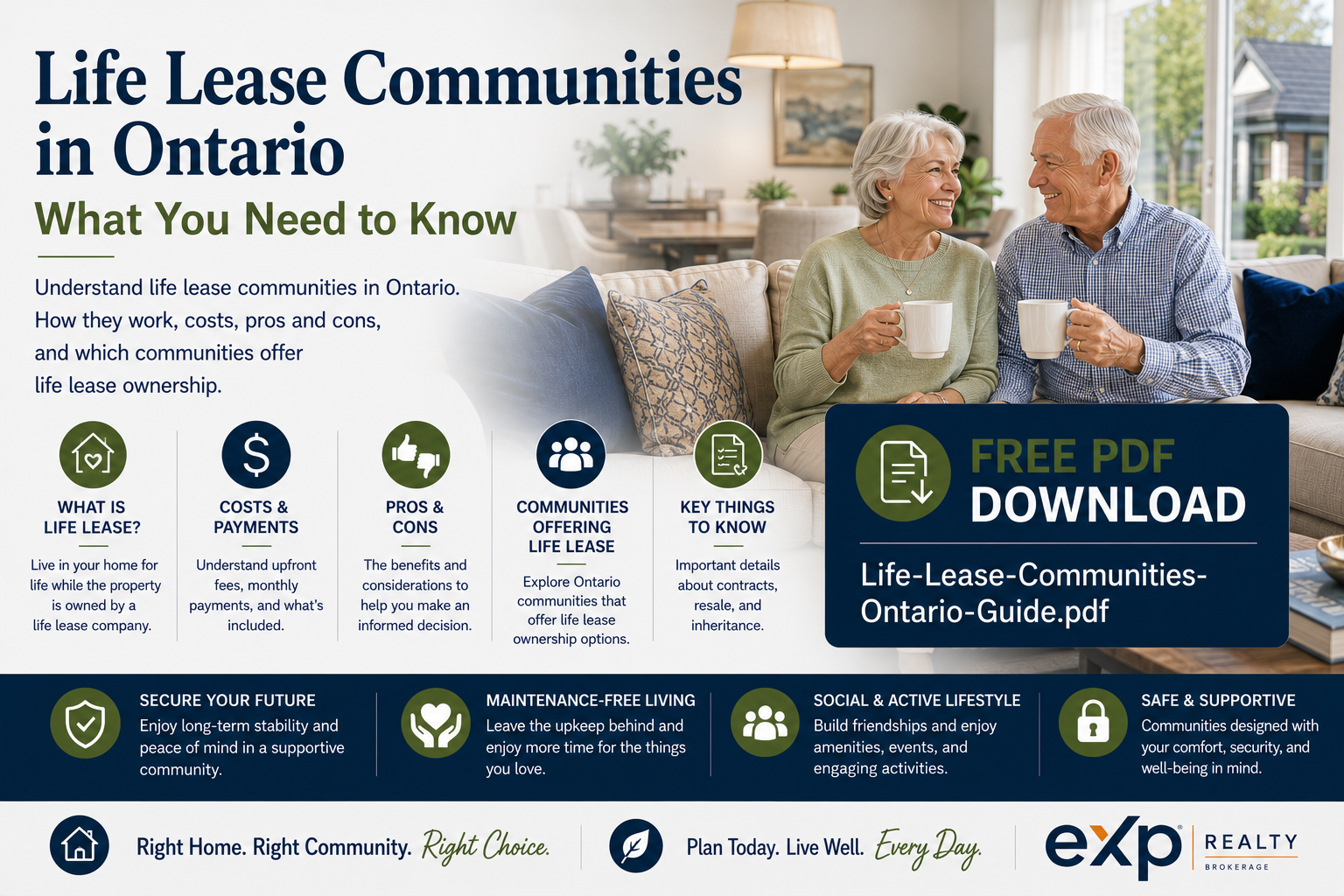
Click the image above to download your free Life Lease Communities in Ontario Guide (PDF).
Ontario Life Lease Community Comparison
Compare key details of these communities to help narrow down your search. Prices and fees are approximate and subject to change.
| Community Name | Location | Ownership Model | Operator / Sponsor | Approx. Price Range |
|---|---|---|---|---|
| Townsend Meadows | Forest, Lambton Shores | Life Lease (market value) | Forest Non-Profit Seniors Housing Corp | $350,000 to $450,000 |
| The Gardens by Maranatha | Burlington, Halton | Life Lease (market value) | Maranatha (non-profit) | $450,000 to $700,000 |
| St. Paul's Terrace | Scarborough, Toronto | Life Lease | St. Paul's Housing (non-profit) | $328,000 to $500,000 |
| The Gallery at Bennett Village | Georgetown, Halton Hills | Life Lease (market value) | Bennett Village (non-profit) | $395,000 to $700,000 |
| The Meadows of Aurora | Aurora, York Region | Life Lease (market value) | The Meadows of Aurora (Christian non-profit) | $500,000 to $800,000 |
| Christie Gardens | Toronto | Life Lease + Rental | Christie Gardens Apartments and Care | $600,000+ |
| Juniper Gate Active Living | Georgetown, Halton Hills | Freehold (new build alternative) | Remington Group | $800,000 to $1.39M |
Pros and Cons of Life Lease Communities
Every housing model has trade-offs. Here is an objective look at the advantages and disadvantages of choosing a life lease community for your retirement.
- Pro: Exemption from Land Transfer Tax
- Because a life lease is not a transfer of land title, buyers do not pay provincial or municipal land transfer taxes, saving thousands of dollars upfront.
- Pro: Non-Profit Management
- Sponsors are typically non-profit organizations, meaning monthly fees are set to cover actual operating costs and reserve funds, rather than generating a corporate profit.
- Pro: Age-Exclusive Environment
- Sponsors have greater control over the demographic composition of the community than condo boards do, ensuring the environment remains focused on mature adults.
- Con: Financing Challenges
- Because you do not hold the title to the real estate, traditional mortgages are not available. Buyers must pay cash, use bridge financing, or secure a personal line of credit.
- Con: Transfer Fees
- When you sell your life lease interest, the sponsor typically charges an administrative or transfer fee, which can range from 3% to 10% of the sale price.
- Con: Regulatory Differences
- Life leases are not governed by the Condominium Act or the Residential Tenancies Act. While some sponsors voluntarily follow similar transparency practices, there is currently no dedicated provincial legislation governing life leases in Ontario.
Understanding Costs & Fees
Budgeting for a life lease community requires looking at both the upfront purchase and the ongoing monthly obligations. Here is what you need to know.
The Purchase Price: Prices for life lease suites typically range from $200,000 to $600,000, though luxury developments can be higher. This is often lower than the cost of a comparable condominium in the same area. However, because traditional mortgages are unavailable, you must have the capital readily available, usually from the sale of your previous home.
The Monthly Maintenance Fee: Residents pay a monthly fee that typically ranges from $400 to $900. This fee generally covers your share of the common area utilities, exterior building maintenance, landscaping, snow removal, building insurance, and contributions to a capital reserve fund. In some communities, it may also cover the maintenance of your suite's heating and cooling systems.
Property Taxes: While you do not own the land, you are still responsible for your share of the municipal property taxes, similar to residents in a condominium. The sponsor typically receives a single tax bill for the entire property and then divides the cost among the residents, either including it in the monthly maintenance fee or billing it separately.
The Market Value Model Explained
While there are several ways a life lease can be structured (such as fixed value or declining balance), the vast majority of communities in Ontario operate under the Market Value Model. This is the model that functions most like traditional homeownership.
Under the Market Value Model, you acquire your life lease interest based on the current market value of the suite. You have the exclusive right to occupy the suite for as long as you wish. When you decide to leave, or upon your passing, you or your estate can sell the life lease interest on the open market at its new, appreciated market value.
This means that if the local real estate market goes up, the value of your life lease interest goes up as well. You retain the equity growth, allowing you to protect your investment over time. The only deduction is the administrative transfer fee paid to the sponsor organization, which covers their costs in facilitating the transfer and maintaining the community's financial health.
How to Choose the Right Community
Selecting the right life lease community involves careful evaluation of the sponsor organization, the lease agreement, and the lifestyle offered.
- Review the Occupancy AgreementBefore making a commitment, have your lawyer review the Life Lease Occupancy Agreement. Pay close attention to the rules regarding the sale of the suite, the exact percentage of the transfer fee, and the sponsor's policies on subletting or renting.
- Assess the Sponsor's Track RecordResearch the non-profit or charitable organization acting as the sponsor. Do they have a history of successfully managing housing projects? Ask to see their reserve fund studies and recent financial statements to ensure the community is on solid financial footing.
- Understand the Support ServicesSome life lease communities are strictly independent living, while others, like Christie Gardens, offer a continuum of care with access to assisted living services. Choose a community that aligns with your anticipated future needs.
For more guidance, read our comprehensive article on Questions to Ask Before Buying into a 55 Plus Community.
Selling Your Current Home to Fund Your Life Lease Purchase
For most downsizers, the move to a life lease community is funded entirely by the equity in their current home. Because traditional mortgages are not available for life lease properties, maximizing your cash from the sale is absolutely critical to ensuring a smooth transition.
Kevin Flaherty has spent over 38 years, since 1988, helping south-central Ontario homeowners sell long-held family homes, with more than $500M sold. His marketing system, built around Video Narrated VR Animated Online Showings, presents your home to buyers across the province before they ever book a visit, which means the showings you do host are with serious, pre-qualified buyers. Read our guide to selling your home to buy into a 55 plus community, or start with a free home evaluation.
Not Sure What Your Current Home Is Worth?
Before you tour a single life lease community, find out exactly how much buying power your current home gives you. Kevin provides free, no-obligation evaluations with no pressure and no strings attached.
Start Your Home EvaluationA comprehensive PDF checklist to help you compare sponsors, evaluate lease agreements, and track your favourite properties across Ontario.
Frequently Asked Questions
What is a life lease community?
A life lease community is a housing development where residents purchase the right to occupy a suite for their lifetime, rather than owning the property outright. The property is typically owned and managed by a non-profit or charitable sponsor organization.
How does life lease work in Ontario?
In Ontario, you purchase a life lease interest, which gives you exclusive use of your suite and shared amenities. You pay an upfront purchase price and ongoing monthly maintenance fees. When you leave, you can sell your interest, typically at market value.
How much does a life lease cost in Ontario?
Purchase prices typically range from $200,000 to $600,000, depending on the location, size of the suite, and the amenities offered by the community. Luxury suites in prime locations can cost significantly more.
What do monthly life lease fees cover?
Monthly fees usually cover common area utilities, exterior building maintenance, landscaping, snow removal, building insurance, and contributions to a reserve fund. They may also include property taxes, depending on how the sponsor structures the billing.
Can you get a mortgage on a life lease?
Kevin advises clients that traditional mortgages are generally not available because you do not hold the title to the real estate. Buyers typically fund the purchase with cash from a previous home sale, bridge financing, or a personal line of credit.
Do you pay land transfer tax on a life lease?
No. Because purchasing a life lease interest is not considered a conveyance of land under Ontario law, buyers are exempt from paying provincial and municipal land transfer taxes.
What happens to a life lease when you die?
The life lease interest typically transfers to your estate. Your inheritors can benefit from the financial value of the lease by selling it, but they cannot automatically move into the suite unless they meet the community's age and approval requirements.
Is a life lease a good investment?
Kevin notes that under the market value model, a life lease can be a solid investment. You benefit from the appreciation of the local real estate market, allowing you to protect your equity over time, similar to owning a condominium.
What is the difference between life lease and condo?
In a condo, you own the title to your specific unit and are governed by the Condominium Act. In a life lease, you own a contractual right to occupy the suite, and the community is governed by the terms of the occupancy agreement set by the sponsor.
What is the difference between life lease and land lease?
In a land lease, you own the physical house but rent the lot it sits on. In a life lease, you do not own the physical structure; you own the right to occupy a suite within a building owned entirely by the sponsor.
Who owns the property in a life lease community?
The physical property, including the land and the buildings, is owned by the sponsor organization. This sponsor is usually a non-profit corporation, a charity, a religious institution, or a service club.
What are the disadvantages of a life lease?
Kevin points out that the main disadvantages are the inability to secure a traditional mortgage, the transfer fees charged by the sponsor upon resale, and the lack of dedicated provincial legislation governing life leases, which requires buyers to rely heavily on the specific contract terms.
Are life leases regulated in Ontario?
There is currently no specific provincial legislation, like a Life Leases Act, governing these communities in Ontario. They are not covered by the Condominium Act or the Residential Tenancies Act. The relationship is governed entirely by the occupancy agreement.
What is the market value life lease model?
This is the most common model in Ontario. It allows residents to buy their life lease interest at current market prices and sell it later at the new, appreciated market value, retaining the equity growth minus an administrative fee.
What admin or transfer fees apply when selling?
When you sell your life lease interest, the sponsor typically charges a transfer fee. This fee varies by community but generally ranges from 3% to 10% of the final sale price.
Can I sell my life lease unit myself?
Kevin advises that while you can technically sell it yourself, having professional real estate representation is highly recommended. An agent can help market the suite, navigate the specific sponsor approval processes, and ensure you get fair market value.
Can I rent out my life lease suite?
In most cases, no. Life lease communities are designed for owner-occupiers to maintain a stable, secure environment. Most occupancy agreements strictly prohibit subletting or renting the suite to third parties.
Can my children inherit my life lease?
Your children can inherit the financial value of the life lease interest. However, they cannot simply move into the suite unless they meet the community's minimum age requirement (often 55+) and are approved by the sponsor's board of directors.
Do life lease communities offer care services?
It depends on the community. Some are strictly independent living, while others are part of a larger continuum-of-care campus that offers access to assisted living, meal plans, and personal care services as your needs change.
Are pets allowed in life lease communities?
Many communities are pet-friendly, but they almost always have strict rules regarding the number, size, and breed of pets allowed. You must review the specific community bylaws before purchasing if you plan to bring a pet.
Which Ontario communities offer life lease?
Kevin notes that there are about 150 projects across the province. Notable examples include Townsend Meadows in Lambton Shores, The Gardens by Maranatha in Burlington, and St. Paul's Terrace in Toronto.
How do I choose the right life lease community?
Kevin suggests focusing on the financial health of the sponsor organization, the specific terms of the occupancy agreement, the amenities offered, and whether the community provides the level of social engagement or future care services you desire.
Should I sell my house before buying a life lease?
Kevin strongly recommends selling your current home first. Because you cannot get a traditional mortgage for a life lease, you need the cash from your sale readily available to fund the purchase and secure your suite.
How do I sell my current home to fund a life lease purchase?
Kevin recommends using a comprehensive marketing approach like Video Narrated VR Animated Online Showings. This system maximizes your home's exposure, helping you secure top dollar quickly so you have the necessary funds ready for your life lease purchase.
Watch: A Backstage Tour of the Seller Marketing Plan
If you need to sell your current home before moving to a life lease community, this video provides a backstage tour of the seller marketing plan. It shows how Video Narrated VR Animated Online Showings highlight all of a home's key features and benefits online, where buyers shortlist homes they are willing to go see.
How to Get Top Dollar for Your House
A backstage tour of the seller marketing plan, showing how Video Narrated VR Animated Online Showings highlight all of a home's key features and benefits online, where buyers shortlist homes they are willing to go see.
10 Questions You Should Ask Before Hiring A REALTOR
Essential questions to ask any agent before listing your home.
Why Didn't My House Sell?
Understanding the common reasons homes fail to sell on the first try.
How to Avoid Legal Mistakes When Selling
Protect yourself from common legal pitfalls during the selling process.
Passing the Building Inspection
How to prepare your home so it passes the buyer's inspection smoothly.
Client Success Stories
Read what downsizers have to say about working with Kevin Flaherty to sell their family homes.
"Kevin and his team made our transition from a large family home to a retirement community seamless. His knowledge of the different ownership models saved us from making a costly mistake."
"We were overwhelmed by the options until Kevin walked us through exactly what to look for. His Video Narrated VR Animated Online Showings let us tour communities without driving all over Ontario."
Local Expertise: Kevin's Service Areas
If you are selling a home in south-central Ontario to fund your move to a 55 plus community, Kevin Flaherty provides expert listing services across these core regions:
Related 55 Plus Community Guides
Explore other location guides and helpful resources for finding your ideal 55 plus community.

About Kevin Flaherty
Kevin Flaherty is a Real Estate Broker with over 38 years of experience since 1988 and more than $500M sold. Operating out of Orangeville, he specializes in helping clients across south-central Ontario sell their long-held family homes and downsize into adult lifestyle communities. His proprietary Video Narrated VR Animated Online Showings ensure sellers get maximum exposure and top dollar, making the transition to retirement living seamless and financially secure. Call or text toll-free at 1-877-352-4378, or reach Kevin direct at 226-270-6433.
A complete checklist covering life lease terms, sponsor comparisons, and worksheets to help you choose the right Ontario life lease community.