Life Lease vs Freehold vs Land Lease
Comparing life lease, freehold, land lease, and condo ownership models reveals significant differences in upfront costs, monthly fees, and long-term equity. Use this guide from Kevin Flaherty to understand which ownership model aligns best with your retirement lifestyle and budget.
Start Your Home Evaluation Download Guide (PDF)Browse All Ontario 55+ Community Listings
Looking for comparable properties or want to see what is currently on the market? Our master directory shows ALL current MLS listings across Ontario, updated daily.
View All Ontario 55+ Community ListingsYour Ontario Ownership Models Guide Map
Jump to any section below:
Common Questions About Retirement Ownership Models
What is the difference between a life lease and a land lease?
In a land lease, you purchase and own the physical house but rent the lot it sits on from a landlord. In a life lease, you do not own the physical house or the land; instead, you purchase an "interest in property" that gives you the right to occupy the unit for life, usually governed by a non-profit sponsor.
Is a life lease a good idea for seniors?
A life lease can be an excellent idea for seniors seeking community living at a lower upfront cost. Because you are buying the right to occupy rather than the real estate itself, prices are typically lower than freehold homes, and sponsors often provide extensive maintenance and social programming tailored to retirees.
Which ownership model is cheapest upfront?
Life lease and land lease models are typically the most affordable upfront. Because you are not purchasing the underlying land in either scenario, the initial capital required is significantly lower than buying a comparable freehold property or standard condominium.
Can you get a mortgage on a life lease or land lease home?
Securing a traditional mortgage for a life lease or land lease is difficult because you do not own the land. While some specialized loans exist, most downsizers fund these purchases using cash from the sale of their previous freehold home.
Do land lease and life lease homes gain equity?
Land lease homes can appreciate, but typically slower than freehold homes because you do not own the land. Life lease equity depends entirely on the sponsor's specific model; "market value" life leases allow you to profit if the market rises, while "fixed value" or "declining balance" models do not.
When searching for a 55 plus community in Ontario, the ownership model you choose dictates your upfront costs, your ongoing monthly fees, and your long-term equity. The four primary models available to retirees are freehold, condominium, land lease, and life lease. Freehold communities offer traditional home and land ownership with the highest upfront costs but the greatest long-term appreciation. Condominium communities provide ownership of your unit with shared maintenance of common elements, funded by monthly condo fees.
For those looking to free up more capital for retirement, alternative models are highly attractive. In a land lease community, you own the physical house but rent the lot it sits on, significantly lowering the purchase price in exchange for a permanent monthly lot fee. A life lease operates differently: you purchase the right to occupy a unit for life, usually from a non-profit or charitable sponsor, without owning the real estate itself. This model is unique to seniors' housing and offers extensive community support, though it requires careful legal review of the specific payback structure.
Understanding the nuances of these models is essential before making an offer. Each structure is governed by different regulations. For instance, land lease parks fall under the Residential Tenancies Act, while life leases rely heavily on individual contract law. My goal is to help you compare these options clearly, ensuring you select the community that best supports your financial security and lifestyle goals.
Kevin's Experience with Downsizers
Over my 38 years in real estate, since 1988, I have seen many clients initially fixate on finding a traditional freehold bungalow, only to realize that a land lease or life lease model actually serves their retirement goals better. When we sit down and run the numbers, freeing up $300,000 in equity by choosing a land lease often provides the travel and lifestyle budget they truly want. My job is to ensure they understand the trade-offs, particularly the ongoing monthly fees, so they can make that choice with complete confidence.
Featured Ontario Communities by Ownership Model
To help you visualize these differences, here are examples of prominent 55 plus and adult lifestyle communities across Ontario, categorized by their specific ownership structure.
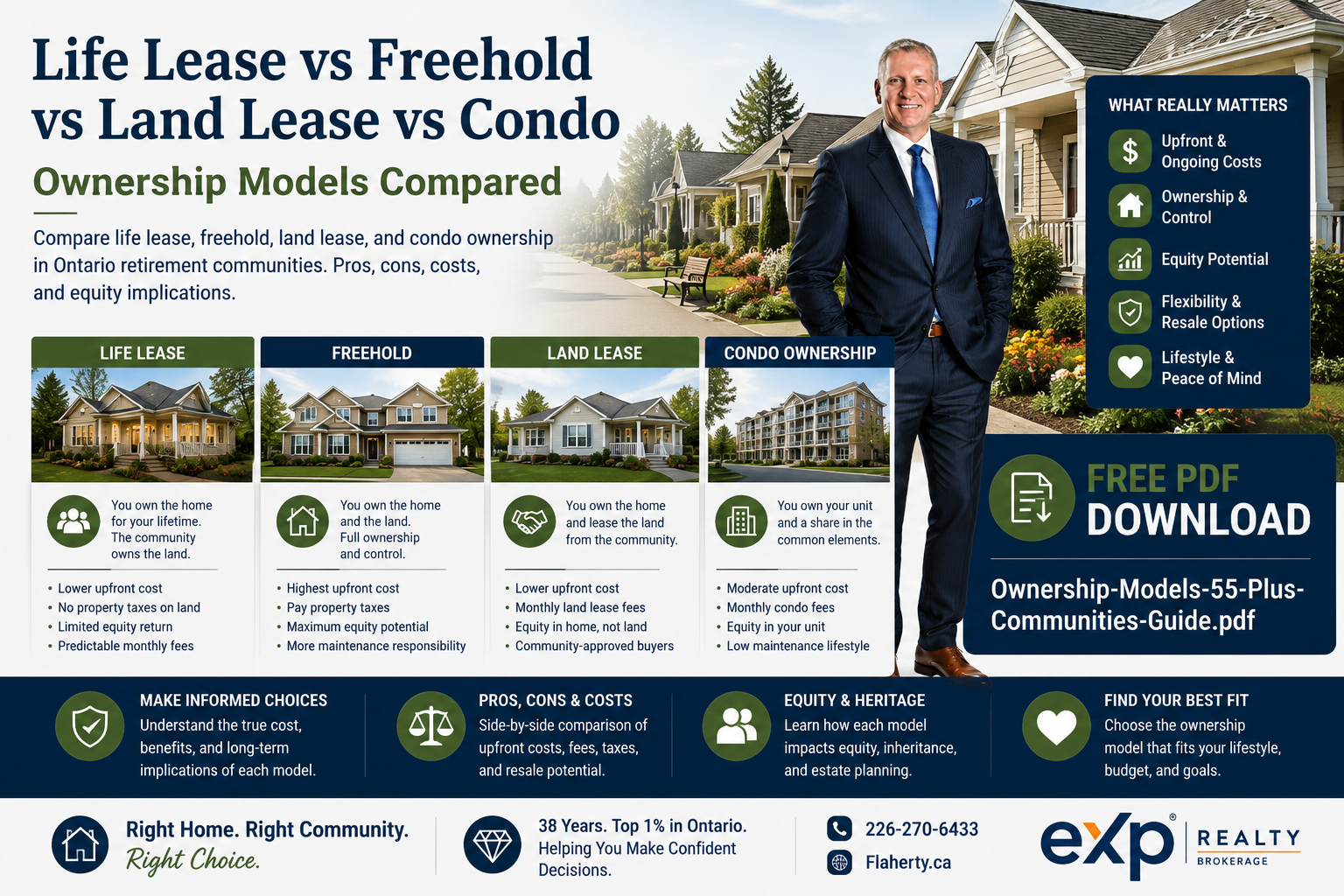
Click the image above to download your free Ownership Models Comparison Guide (PDF).
Ownership Model Comparison
Compare the fundamental differences between the four primary ownership models available in Ontario retirement communities.
| Feature | Freehold | Condominium | Land Lease | Life Lease |
|---|---|---|---|---|
| What You Own | Home and Land | Unit (plus share of common elements) | Home only | Right to occupy (Interest in property) |
| Monthly Fees | None (or small association fee) | Yes (Condo fees) | Yes (Lot rent) | Yes (Maintenance fees) |
| Equity Growth | Full market appreciation | Full market appreciation | Slower appreciation (home only) | Depends on sponsor's specific model |
| Property Taxes | Paid directly to municipality | Paid directly to municipality | Often included in lot rent | Often included in monthly fee |
| Mortgage Availability | Standard mortgages apply | Standard mortgages apply | Difficult (Chattel mortgages only) | Difficult (Specialized loans only) |
Pros and Cons by Ownership Model
Every model has distinct trade-offs. Here is an objective look at the advantages and disadvantages of each option.
- Freehold: Pros
- You have complete control over your property, benefit from maximum equity appreciation, and have no mandatory monthly maintenance fees eating into your fixed income.
- Freehold: Cons
- Requires the highest upfront purchase price, and you remain entirely responsible for all exterior maintenance, landscaping, and snow removal.
- Condominium: Pros
- Offers a completely maintenance-free lifestyle where exterior repairs and landscaping are handled by the condo corporation. You still own real estate and build equity.
- Condominium: Cons
- Monthly condo fees are mandatory and subject to annual increases. You must also comply with the condo board's strict rules regarding pets, renovations, and rentals.
- Land Lease: Pros
- Significantly lower upfront purchase price allows you to unlock equity from your previous home. Professional management handles community amenities.
- Land Lease: Cons
- You will pay a permanent monthly lot fee that increases annually. Securing a traditional mortgage is very difficult, and the home may appreciate slower than a freehold property.
- Life Lease: Pros
- Often the most affordable entry point, designed specifically for seniors with built-in social programming and accessibility features. Guaranteed housing security for life.
- Life Lease: Cons
- You do not own the real estate. Depending on the contract, you or your estate may not profit from market appreciation, and selling the lease can involve significant administrative fees paid to the sponsor.
Understanding Costs & Fees
Budgeting for your move requires looking at both the upfront purchase and the ongoing monthly obligations. Here is a general breakdown of what to expect across Ontario.
- Freehold CommunitiesExpect purchase prices typically ranging from $500,000 to over $1.2 million. Your ongoing costs will include standard property taxes, utilities, and your own maintenance expenses.
- Condominium CommunitiesPurchase prices generally range from $400,000 to $900,000. You must also budget for monthly condo fees, which typically run between $300 and $800, covering exterior maintenance and shared amenities.
- Land Lease CommunitiesThese offer a very accessible entry point, with purchase prices typically between $200,000 and $500,000. However, you will pay a monthly lot lease fee, generally ranging from $500 to $1,200, which covers the land rental.
- Life Lease CommunitiesInitial entrance fees typically range from $200,000 to $600,000. You will also pay a monthly maintenance fee, generally between $400 and $900, which often includes property taxes, exterior maintenance, and community programming.
For a detailed breakdown of ongoing expenses, review our guide on Monthly Fees in 55 Plus Communities.
Deep Dive: The Five Types of Life Lease Models
If you are considering a life lease, it is critical to understand that not all life leases are the same. The provincial government recognizes five distinct economic models that determine what happens to your investment when you move or pass away.
1. Market Value: The most popular model in Ontario. You or your estate sell the life lease at current market rates. You keep the profit (or absorb the loss), minus an administrative transfer fee paid to the sponsor.
2. Price Index: The sponsor buys the lease back from you at your original purchase price plus an annual percentage increase tied to an index, usually the Consumer Price Index (CPI).
3. Fixed Value: Also known as the "no gain" model. The sponsor buys the lease back for the exact amount you originally paid. You do not lose money if the market drops, but you do not gain equity, meaning inflation erodes the value of your capital over time.
4. Declining Balance: You pay an upfront amount based on life expectancy. If you leave, you or your estate receive a refund that declines by a specific percentage each year until it reaches zero. It functions like prepaid rent.
5. Zero Balance: The least expensive option upfront. You pay a lump sum designed to cover rent for the rest of your life. When you leave or pass away, the lease returns to the sponsor with zero residual value paid to your estate.
How to Choose the Right Model
Selecting the right ownership structure involves careful evaluation of your financial goals, your desire for maintenance-free living, and your estate planning preferences.
- Evaluate Your Need for Cash FlowIf your goal is to maximize the cash in your bank account for travel and hobbies, land lease or life lease models require the lowest upfront investment, freeing up equity from your previous home sale.
- Assess Your Tolerance for Monthly FeesIf you are on a strict fixed income and worry about inflation, a freehold property protects you from mandatory, escalating monthly fees (like lot rent or condo fees).
- Consider Your Estate PlansIf leaving a substantial financial legacy to your children is a priority, freehold and market-value condo models offer the best chance for long-term equity growth. Zero-balance life leases leave no real estate asset to your heirs.
- Review the Legal DocumentsNever sign a life lease or land lease agreement without having your real estate lawyer review the fine print. Pay special attention to transfer fees, rules regarding fee increases, and the specific terms for selling the home in the future.
Selling Your Current Home to Fund Your 55 Plus Community Purchase
For most downsizers, the move to a retirement community, whether freehold, condo, land lease, or life lease, is funded entirely by the equity in their current home. Because traditional mortgages are harder to secure for land lease and life lease properties, maximizing your cash from the sale is critical.
Kevin Flaherty has spent over 38 years, since 1988, helping south-central Ontario homeowners sell long-held family homes, with more than $500M sold. His marketing system, built around Video Narrated VR Animated Online Showings, presents your home to buyers across the province before they ever book a visit, which means the showings you do host are with serious, pre-qualified buyers. Read our guide to selling your home to buy into a 55 plus community, or start with a free home evaluation.
Not Sure What Your Current Home Is Worth?
Before you decide which ownership model you can afford, find out exactly how much buying power your current home gives you. Kevin provides free, no-obligation evaluations with no pressure and no strings attached.
Start Your Home EvaluationA comprehensive PDF checklist to help you compare freehold, condo, land lease, and life lease options, evaluate amenities, and track your favourite properties.
Frequently Asked Questions
What is the difference between life lease, freehold, and land lease?
In a freehold community, you own the home and the land. In a land lease community, you own the home but rent the land. In a life lease, you own neither the home nor the land; instead, you purchase the right to occupy the unit for your lifetime.
What is a life lease in Ontario?
A life lease is an 'interest in property' that gives you the right to live in a unit, usually for the duration of your life. The building is typically owned by a non-profit or charitable sponsor. You pay an upfront entrance fee and ongoing monthly maintenance fees.
What is a land lease community?
A land lease community is a residential development where you purchase and own the physical house, but you rent the lot it sits on from the community operator. You pay a monthly lot fee that covers the land rental and often shared amenities.
What does freehold mean in a 55+ community?
Freehold means you hold the deed to both the physical structure of the home and the plot of land it sits on. You have full ownership rights and responsibilities, and you do not pay lot rent, though there may be a small association fee for shared community amenities.
Is a condo different from all three?
Yes. In a standard condominium, you own your specific unit (the interior space) and hold a shared interest in the common elements (hallways, exterior, grounds). You pay mandatory monthly condo fees to a condo corporation for the upkeep of those common elements.
Which ownership model is cheapest upfront?
Life lease and land lease models are generally the cheapest upfront because you are not purchasing the underlying land. This allows downsizers to move into a community for significantly less capital than buying a comparable freehold property.
Which model has the lowest monthly costs?
Freehold ownership typically has the lowest mandatory monthly costs, as you only pay your standard property taxes and utilities. Condos, land leases, and life leases all require mandatory monthly fees that are subject to annual increases.
Can I get a mortgage on a land lease home?
In Kevin's experience, securing a traditional mortgage for a land lease home is very difficult because the bank cannot use the land as collateral. Buyers typically use cash from a previous home sale or secure a specialized chattel mortgage or line of credit.
Can I get a mortgage on a life lease?
Securing a traditional mortgage on a life lease is generally not possible because you do not hold the deed to the property. Some financial institutions offer specialized loans for life leases, but most buyers fund the purchase with cash from downsizing.
Do land lease homes appreciate?
Yes, Kevin notes that homes in land lease communities can appreciate in value, but typically at a slower rate than freehold homes. The appreciation is tied to the physical structure and community desirability, rather than the underlying land value.
Do life lease units gain equity?
This depends entirely on the specific life lease contract. 'Market value' life leases allow you to sell the lease at current market rates and keep the profit. However, 'fixed value' or 'declining balance' models do not allow for equity growth.
What happens to a life lease when I die?
In most market value life leases, the lease interest transfers to your estate, and your inheritors can sell it. However, your inheritors cannot move into the unit unless they apply to the sponsor and meet the community's age and eligibility criteria.
What are the five types of life lease models?
The Ontario government recognizes five life lease economic models: market value, price index, fixed value, declining balance, and zero balance. Market value is the most common, allowing the holder to profit from real estate appreciation.
Is land lease covered by the RTA?
Yes, land lease communities and mobile home parks in Ontario are generally governed by the Residential Tenancies Act (RTA), which provides rules regarding lot fee increases and tenant protections. Life leases, however, are not covered by the RTA.
Is Briar Hill freehold or condo?
Kevin clarifies that the majority of homes in Briar Hill are freehold or common-element condominium (site condominium) properties where residents own both the home and the land. They pay property taxes plus a monthly maintenance fee covering shared amenities.
Is Green Briar freehold?
No, Green Briar is comprised of condominium-registered properties governed by 16 different condo corporations. Residents own their homes and land through a condo-registered title and pay monthly fees for common element maintenance.
Which model is best for resale value?
Kevin advises that freehold communities generally offer the best resale value and strongest long-term equity growth, as you benefit from the appreciation of both the physical structure and the underlying land.
Are monthly fees regulated?
Lot fees in land lease communities are generally regulated by the Residential Tenancies Act. Condo fees are governed by the Condominium Act and are based on the corporation's annual budget. Life lease maintenance fees are dictated by the sponsor's operating costs and the lease agreement.
What is a status certificate and when do I need one?
A status certificate is a document provided by a condo corporation that details the financial and legal health of the corporation, including the reserve fund. You need your lawyer to review this document before finalizing the purchase of any condominium property.
Can my children inherit my home in each model?
Kevin notes that your children can inherit a freehold, condo, or land lease home. With a life lease, they generally inherit the financial value of the lease (to be sold), but they cannot occupy the unit unless they meet the community's age restrictions.
Which ownership model is best for a fixed retirement income?
Kevin often recommends freehold ownership for those strictly concerned about fixed incomes, as it eliminates the risk of escalating monthly lot rents or condo fees, provided you can afford the higher upfront purchase price and handle your own maintenance.
What should my lawyer review before I buy?
Kevin stresses that your lawyer must review the specific agreements for your chosen model: the land lease agreement for lot rent terms, the status certificate for condos, or the specific life lease contract to understand transfer fees and the economic payback model.
Are property taxes different across models?
Yes. In freehold and condo models, you pay property taxes directly to the municipality based on the assessed value of your home and land. In land lease and life lease models, property taxes are often rolled into your monthly lot rent or maintenance fee.
How do I sell my current home to fund the purchase?
Kevin recommends coordinating the sale of your current home carefully with your purchase. Using a system like Video Narrated VR Animated Online Showings can help sell your family home efficiently, ensuring you have the equity ready when you find the right community.
Watch: A Backstage Tour of the Seller Marketing Plan
If you need to sell your current home before moving to a 55 plus community, this video provides a backstage tour of the seller marketing plan. It shows how Video Narrated VR Animated Online Showings highlight all of a home's key features and benefits online, where buyers shortlist homes they are willing to go see.
How to Get Top Dollar for Your House
A backstage tour of the seller marketing plan, showing how Video Narrated VR Animated Online Showings highlight all of a home's key features and benefits online, where buyers shortlist homes they are willing to go see.
10 Questions You Should Ask Before Hiring A REALTOR
Essential questions to ask any agent before listing your home.
Why Didn't My House Sell?
Understanding the common reasons homes fail to sell on the first try.
How to Avoid Legal Mistakes When Selling
Protect yourself from common legal pitfalls during the selling process.
Passing the Building Inspection
How to prepare your home so it passes the buyer's inspection smoothly.
Client Success Stories
Read what downsizers have to say about working with Kevin Flaherty to sell their family homes.
"Kevin and his team were absolutely amazing. From start to finish, they made selling our home seamless. The marketing was incredible, the communication was constant, and we got more than we expected. I would recommend Kevin to anyone looking to sell."
"We were nervous about selling after 25 years in our home, but Kevin made it so easy. His online showing system brought buyers from across Ontario, and we sold in under a week. The whole process was stress-free."
Local Expertise: Kevin's Service Areas
If you are selling a home in south-central Ontario to fund your move to a 55 plus community, Kevin Flaherty provides expert listing services across these core regions:
Related 55 Plus Community Guides
Explore other location guides and helpful resources for finding your ideal 55 plus community.

About Kevin Flaherty
Kevin Flaherty is a Real Estate Broker with over 38 years of experience since 1988 and more than $500M sold. Operating out of Orangeville, he specializes in helping clients across south-central Ontario sell their long-held family homes and downsize into adult lifestyle communities. His proprietary Video Narrated VR Animated Online Showings ensure sellers get maximum exposure and top dollar, making the transition to retirement living seamless and financially secure. Call or text toll-free at 1-877-352-4378, or reach Kevin direct at 226-270-6433.
A complete checklist covering freehold, condo, land lease, and life lease terms, community comparisons, and worksheets to help you choose the right Ontario community.