What Is a 55 Plus Community?
A 55 plus community is an age-restricted residential neighbourhood designed for active adults, offering low-maintenance living with shared amenities like clubhouses and pools. Discover how they work, what they cost, and how Kevin Flaherty helps downsizers transition seamlessly into these communities.
Start Your Home Evaluation Download Guide (PDF)Browse All 55+ Communities in Ontario
Looking for a comprehensive directory of adult lifestyle communities? This dedicated page shows ALL current MLS listings in 55 plus communities across Ontario, updated daily.
View All 55+ CommunitiesYour Guide to 55 Plus Communities
Jump to any section below:
Common Questions About 55 Plus Communities
What does adult lifestyle community mean?
An adult lifestyle community is another term for a 55 plus community. These are planned residential developments designed specifically for active, independent older adults who want a low-maintenance home surrounded by peers of a similar age.
Are 55 plus communities worth it?
For many downsizers, they are highly worthwhile. They provide freedom from exterior maintenance like shoveling snow, offer built-in social networks, and often feature amenities like pools and clubhouses that would be expensive to maintain individually.
What are the rules in a 55 plus community?
Rules typically cover age restrictions for primary residents, limits on how long underage guests can visit, guidelines for exterior home modifications, and policies regarding pets. These rules ensure the community remains quiet and adult-oriented.
Who can live in a 55 plus community?
Generally, at least one person in the household must be 55 or older. Some communities allow a younger spouse, while others strictly require all permanent residents to meet the age threshold. Children under 18 cannot be permanent residents.
What is the difference between 55 plus and retirement home?
A 55 plus community is for independent living where you own or lease a private home and manage your own meals and healthcare. A retirement home is a care facility providing daily meals, housekeeping, and on-site medical assistance or personal care.
Defining the 55 Plus Community
A 55 plus community is an age-restricted residential development designed specifically to meet the needs of active, independent adults. Also commonly referred to as adult lifestyle communities, these neighbourhoods focus on providing a low-maintenance lifestyle by handling heavy exterior chores such as snow removal and lawn care. They typically feature shared amenities like clubhouses, swimming pools, tennis courts, and organized social activities, fostering a strong sense of community among peers.
Unlike assisted living facilities, these communities are entirely geared toward independent living. Residents own or lease their private homes, cook their own meals, and manage their own healthcare. The primary appeal is the combination of appropriately sized housing, often single-story bungalows, and a vibrant, socially engaged environment where neighbours share similar life stages and interests.
How Do 55 Plus Communities Work?
Operating a 55 plus community requires a structured approach to ensure the environment remains peaceful, well-maintained, and adult-focused. This structure is maintained through specific governance and community rules.
Governance and Management
Most communities are governed by a homeowners' association (HOA), a condominium board, or a property management company, depending on the ownership model. This governing body is responsible for maintaining shared amenities, organizing services like landscaping, and enforcing community standards. Residents pay a monthly fee to cover these operational costs.
Community Rules and Bylaws
To preserve the intended lifestyle, communities enforce bylaws that all residents must follow. These rules govern everything from the types of exterior modifications you can make to your home, to parking regulations and noise ordinances. While these rules might seem restrictive compared to a standard suburban neighbourhood, they are precisely what guarantee the quiet, well-kept environment that draws people to these communities in the first place.
Who Qualifies to Live There?
The defining feature of a 55 plus community is its age restriction, but the application of this rule can vary slightly from one development to another. Understanding these nuances is crucial before you start your search.
Age Requirements and Exceptions
The standard rule is that at least one person residing in the home must be 55 years of age or older. However, many communities offer exceptions for younger spouses. For example, a community might allow a 50-year-old spouse to reside there as long as the primary owner meets the 55-plus requirement. It is vital to review the specific bylaws of any community you are considering, as some are strictly "adults only" and require all residents to be over a certain age.
Visitor Policies
A common concern for downsizers is whether their grandchildren can visit. Yes, grandchildren and younger family members are welcome to visit. However, communities typically enforce rules limiting the duration of these visits, often restricting stays to no more than a few weeks per year, to ensure the neighbourhood does not inadvertently become a family subdivision.
Ownership Models Explained
One of the most important decisions you will make is choosing the right ownership structure. This dictates your upfront costs, ongoing monthly expenses, and the legal nature of your investment.
- Freehold
- You own both the physical home and the land it sits on outright. There are no mandatory monthly community fees, but you are fully responsible for all maintenance and property taxes. This model offers the most independence and equity growth potential.
- Condominium
- You own the home and the land, but you pay a mandatory monthly condo fee. This fee covers the maintenance of shared amenities and typically includes exterior chores like snow shoveling and lawn care. It is an excellent balance of ownership and convenience.
- Land Lease
- You own the physical home, but you rent the lot it sits on from the community operator. This results in a significantly lower purchase price, making it highly affordable upfront, but requires a monthly lot fee. These communities are governed by the Residential Tenancies Act.
- Life Lease
- You purchase the right to occupy a unit for life, usually from a non-profit organization. You pay an upfront sum and a monthly maintenance fee. When you leave, the unit is sold, and you or your estate receives the market value minus an administrative fee.
For a detailed comparison, see our guide on Life Lease vs Freehold vs Land Lease.
| Model | Upfront Cost | Monthly Fees | Land Ownership | Maintenance Responsibility |
|---|---|---|---|---|
| Freehold | Highest | None (Property Tax Only) | Yes | Owner |
| Condominium | High | Moderate to High | Yes | Shared / Condo Corp |
| Land Lease | Lowest | High (Lot Rent) | No | Owner (Home) / Operator (Land) |
| Life Lease | Moderate | Moderate | No (Right to Occupy) | Operator |
What Do 55 Plus Communities Cost?
The cost of living in a 55 plus community in Ontario varies widely based on the location, the amenities offered, and most importantly, the ownership model you select.
If you opt for a land lease community, you can expect the most affordable entry point, with purchase prices typically ranging from $200,000 to $500,000. However, you must budget for a monthly lot fee that generally falls between $500 and $1,200. Condominium communities require a larger upfront investment, usually between $400,000 and $900,000, plus monthly condo fees ranging from $300 to $800. For the ultimate independence of a freehold community, prices typically range from $500,000 to over $1.2 million, with no mandatory monthly community fees beyond your standard property taxes and personal maintenance costs.
For more specific pricing details, explore our guide on How Much Do 55 Plus Communities Cost in Ontario.
55 Plus Community vs. Retirement Home
A common point of confusion is the distinction between a 55 plus community and a retirement home. They serve entirely different needs and stages of life.
A 55 plus community is focused entirely on independent living. You live in your own private home, cook your own meals, and drive your own vehicle. The community provides social amenities and exterior maintenance, but it does not provide any form of healthcare, assisted living, or daily personal support.
A retirement home (or assisted living facility) is a care-oriented environment. Residents typically live in private suites within a larger building and receive daily services such as prepared meals in a dining room, housekeeping, medication management, and access to on-site nursing staff. If you require daily assistance with personal care, a retirement home is the appropriate choice. If you are active and independent but simply want a lower-maintenance lifestyle, a 55 plus community is the better fit. Read our full comparison: 55 Plus Community vs Retirement Home.
Pros and Cons of 55 Plus Communities
Like any major housing decision, moving to an adult lifestyle community comes with distinct advantages and potential drawbacks.
How to Choose the Right Community
Finding the perfect community requires evaluating your financial situation, lifestyle preferences, and long-term needs. Follow these steps to narrow down your options.
- Determine Your Preferred Ownership ModelDecide whether you want the independence of a freehold, the convenience of a condo, or the affordability of a land lease. This decision will immediately filter your options.
- Assess Your BudgetCalculate your buying power by getting a clear understanding of what your current home is worth. Remember to factor in both the purchase price and the ongoing monthly fees of the communities you are considering.
- Prioritize Location and AmenitiesDo you want to stay close to family in the GTA, or are you looking for waterfront living in Collingwood? Make a list of must-have amenities, but be careful not to pay a premium for facilities you won't actually use.
- Tour and Talk to ResidentsWhen visiting a community, look beyond the model home. Speak with current residents about the social atmosphere, the responsiveness of the management, and the overall quality of life.
If you are trying to decide between a traditional condo and a community, read our guide on Condo vs 55 Plus Community.
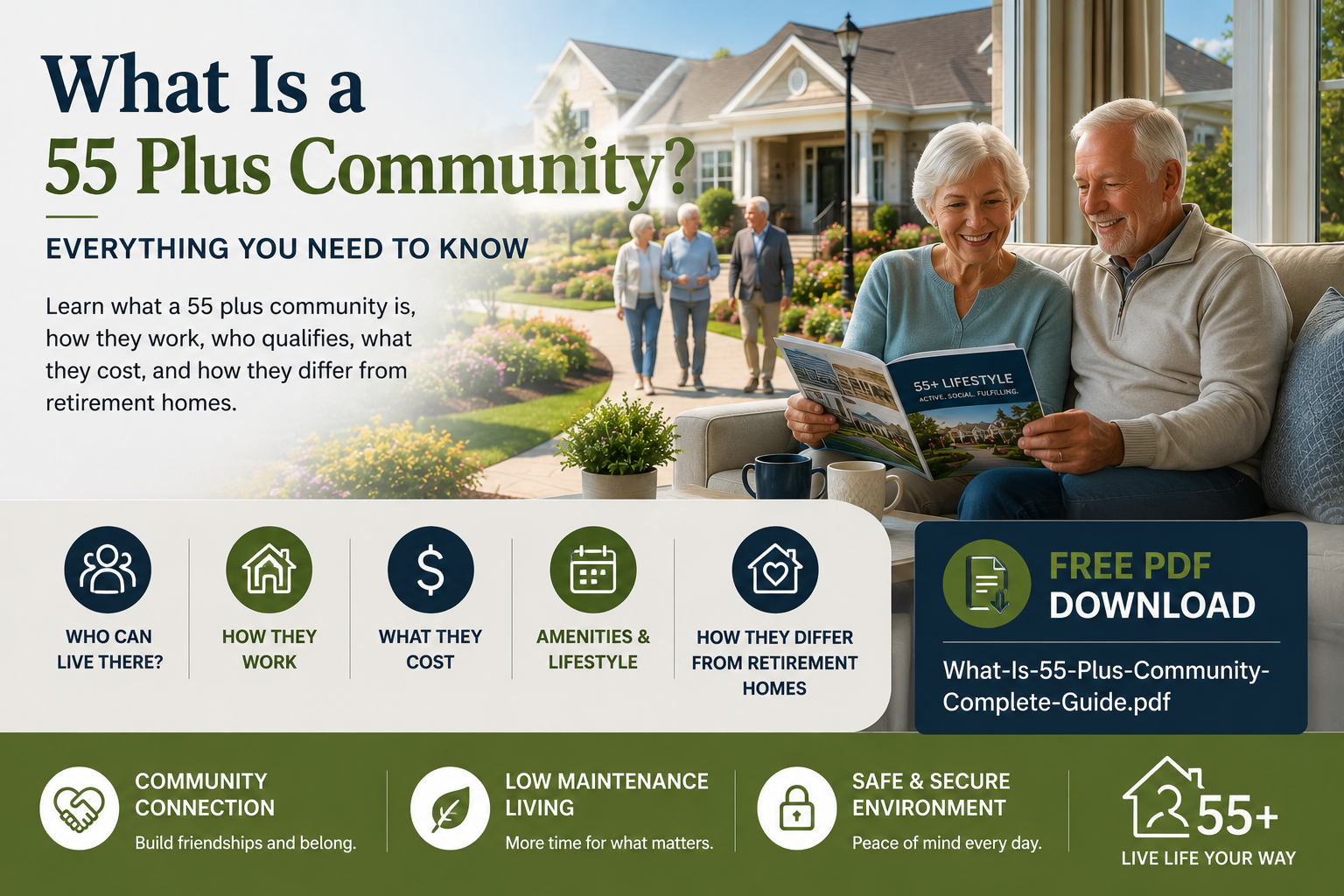
Click the image above to download your free Complete Guide to 55 Plus Communities (PDF).
Selling Your Current Home to Fund Your Move
For most downsizers, the transition to a 55 plus community is entirely dependent on the successful sale of their current family home. Maximizing the equity in your current property is what allows you to comfortably afford the retirement lifestyle you want.
Kevin Flaherty has over 38 years of experience, since 1988, helping Ontario homeowners navigate this exact transition, with over $500M sold. His marketing approach utilizes Video Narrated VR Animated Online Showings to present your home to buyers across the province before they even step through the door. This means fewer disruptions to your daily life and ensures that the buyers who do visit are serious and pre-qualified.
The first step in planning your move is knowing exactly how much buying power you have. Learn more about the process in our guide to selling your home to buy into a 55 plus community.
Not Sure What Your Current Home Is Worth?
Before you start touring communities, find out exactly how much equity you have to work with. Kevin provides free, no-obligation evaluations.
Start Your Home EvaluationA comprehensive PDF guide explaining ownership models, cost expectations, and how to evaluate amenities to find the perfect community for your retirement.
Frequently Asked Questions
What is a 55 plus community?
A 55 plus community is an age-restricted residential development designed for active adults. It offers a low-maintenance lifestyle by handling exterior chores and provides shared amenities like clubhouses and pools.
Do I have to be exactly 55 to live there?
Kevin advises checking the specific community bylaws. Generally, one resident must be 55 or older, but many communities allow a younger spouse to live there as well.
What does adult lifestyle community mean?
Adult lifestyle community is simply another term for a 55 plus community. Both refer to planned neighbourhoods designed for independent, active older adults.
What is the difference between a 55 plus community and a retirement home?
A 55 plus community is for independent living where you own or lease a home. A retirement home is an assisted living facility that provides meals, housekeeping, and medical care.
How do 55 plus communities work?
They are governed by a homeowners' association or management company that enforces community rules and maintains shared amenities, funded by monthly fees paid by the residents.
What are the rules in a 55 plus community?
Rules typically cover age restrictions, limits on visitor stays, pet policies, and guidelines for exterior home modifications to maintain a quiet, uniform environment.
Are 55 plus communities worth it?
Kevin finds that for downsizers seeking a low-maintenance home, built-in social activities, and freedom from exterior chores, these communities are highly worthwhile.
Who can live in a 55 plus community?
Primary residents must meet the age requirement (usually 55+). Children under 18 cannot be permanent residents, though they can visit.
What is a freehold 55 plus community?
In a freehold community, you own both the home and the land outright, with no mandatory monthly community fees, though you handle your own maintenance.
What is a land lease community?
You own the physical home but rent the lot it sits on from the community operator, paying a monthly lot fee. This results in a lower upfront purchase price.
What is a condo 55 plus community?
You own the home and land but pay a mandatory monthly condo fee that covers shared amenities and exterior maintenance like snow removal.
How much do 55 plus communities cost?
Kevin notes that prices vary widely. Land lease homes typically range from $200,000 to $500,000, while freehold homes can range from $500,000 to over $1.2 million.
What are the monthly fees?
Land lease lot fees range from $500 to $1,200. Condo fees range from $300 to $800. Freehold communities have no mandatory monthly fees.
Do these communities provide medical care?
No. They are designed strictly for independent living and do not provide on-site nursing or medical assistance.
Are pets allowed?
Most communities are pet-friendly but have strict bylaws regarding the number, size, and breed of pets allowed.
Can grandchildren visit?
Kevin confirms that visitors of all ages are welcome, but communities enforce rules limiting the length of stay for underage guests, usually to a few weeks per year.
Are they gated?
Kevin explains that some communities are gated for added security, while others are open neighbourhoods. It varies by development.
What is a life lease?
You purchase the right to occupy a unit for life, paying an upfront sum and monthly fees. When you leave, the unit is sold at market value minus an administrative fee.
Do land lease homes appreciate in value?
Kevin advises that they can appreciate, but typically slower than freehold properties, as the value is tied only to the structure and community desirability, not the land.
Can I get a mortgage for a land lease?
Traditional mortgages are difficult to secure since you don't own the land. Buyers often use a chattel mortgage, a line of credit, or cash from a previous home sale.
What happens when a land lease expires?
Leases are typically long-term. As expiration approaches, operators usually offer renewal terms, governed by provincial regulations.
Can I rent out my home in a 55 plus community?
Kevin warns that many condo and land lease communities strictly prohibit renting or subletting to maintain community security and stability.
What should I look for on a tour?
Look past the model home. Inspect the condition of shared amenities, observe the neighbourhood maintenance, and speak with current residents about the lifestyle.
How do I sell my home to buy into one?
Kevin recommends getting a professional home evaluation first to understand your buying power, then using an advanced marketing system to sell your current home efficiently.
Watch: A Backstage Tour of the Seller Marketing Plan
If you need to sell your current home before moving to a 55 plus community, this video provides a backstage tour of the seller marketing plan. It shows how Video Narrated VR Animated Online Showings highlight all of a home's key features and benefits online, where buyers shortlist homes they are willing to go see.
How to Get Top Dollar for Your House
A backstage tour of the seller marketing plan, showing how Video Narrated VR Animated Online Showings highlight all of a home's key features and benefits online, where buyers shortlist homes they are willing to go see.
10 Questions You Should Ask Before Hiring A REALTOR
Essential questions to ask any agent before listing your home.
Why Didn't My House Sell?
Understanding the common reasons homes fail to sell on the first try.
How to Avoid Legal Mistakes When Selling
Protect yourself from common legal pitfalls during the selling process.
Passing the Building Inspection
How to prepare your home so it passes the buyer's inspection smoothly.
Client Success Stories
Read what downsizers have to say about working with Kevin Flaherty to sell their family homes.
"Kevin and his team made our transition from a large family home to a retirement community seamless. His knowledge of the different ownership models saved us from making a costly mistake."
"We were overwhelmed by the options until Kevin walked us through exactly what to look for. His Video Narrated VR Animated Online Showings let us tour communities without driving all over Ontario."
Local Expertise: Kevin's Service Areas
If you are selling a home in south-central Ontario to fund your move to a 55 plus community, Kevin Flaherty provides expert listing services across these core regions:
Related 55 Plus Community Guides
Explore other guides and helpful resources for finding your ideal 55 plus community in Ontario.

About Kevin Flaherty
Kevin Flaherty is a Real Estate Broker with over 38 years of experience since 1988 and more than $500M sold. Operating out of Orangeville, he specializes in helping clients across south-central Ontario sell their long-held family homes and downsize into adult lifestyle communities. His proprietary Video Narrated VR Animated Online Showings ensure sellers get maximum exposure and top dollar, making the transition to retirement living seamless and financially secure. Call or text toll-free at 1-877-352-4378, or reach Kevin direct at 226-270-6433.
A complete checklist covering freehold, condo, and land-lease models, amenity evaluations, and worksheets to help you choose the right 55 plus community.