Illustration of a couple walking hand-in-hand in a scenic outdoor setting with a sunlit background, symbolizing adult lifestyle communities in Ontario, featuring homes and a golf flag, with the text adultcommunities.ca prominently displayed

Ontario's Premier Adult Lifestyle Havens.
Retire with Comfort, Style and Community.

How Much Do 55 Plus Communities Cost in Ontario?

Depending on the ownership model, 55 plus communities in Ontario range from $200,000 to over $1,200,000 for purchase prices, with monthly fees varying from zero to $1,200. Compare the full costs of freehold, condominium, land lease, and life lease communities below.

Start Your Home Evaluation Download Cost Guide (PDF)
18 min read Updated July 2026 Ontario, Canada By Kevin Flaherty, Broker

Browse All 55+ Communities in Ontario

Want to see what is currently available on the market? This dedicated page shows ALL current MLS listings in adult lifestyle communities across Ontario, updated daily.

View All Ontario Listings

Common Questions About 55 Plus Community Costs

How much do 55 plus communities cost in Ontario?

In Ontario, 55 plus community prices vary by ownership model. Land lease homes typically range from $250,000 to $500,000. Condominium homes range from $400,000 to $900,000. Freehold homes are the most expensive, generally ranging from $500,000 to $1,200,000 or more.

What are the monthly fees in retirement communities?

Monthly fees depend on how you own the property. Land lease communities charge lot fees ranging from $500 to $1,200 per month. Condominium communities charge condo fees ranging from $300 to $800 per month. Freehold communities have no mandatory monthly fees, though you pay your own property taxes and maintenance.

What is the total cost of owning in a retirement community?

The total cost of ownership includes your initial purchase price, monthly community fees (if any), property taxes, home insurance, and interior maintenance. Over a 10-year period, a cheaper land lease home with high monthly fees can sometimes cost as much as a more expensive freehold home with zero monthly fees.

Are there hidden costs in 55 plus communities?

Potential hidden costs include special assessments in condominium communities, unexpected lot fee increases in land lease communities, and exit fees or administrative charges in life lease communities. It is crucial to review the status certificate or lease agreement with your lawyer.

Are affordable retirement communities available in Ontario?

Yes, affordable options exist, primarily in the land lease model. Because you rent the lot rather than buying the land, the upfront purchase price is significantly lower, making it accessible for downsizers with limited equity, provided they can budget for the ongoing monthly lot fees.

The Quick Answer: How Much Do They Cost?

The cost of a 55 plus community in Ontario depends entirely on the ownership model you choose. If you want to own the land and avoid monthly fees, freehold homes typically range from $500,000 to $1,200,000. If you prefer a maintenance-free lifestyle, condominium homes range from $400,000 to $900,000 plus $300 to $800 per month in condo fees. For the most affordable upfront price, land lease homes range from $250,000 to $500,000, but require monthly lot fees of $500 to $1,200. Finally, life lease units generally cost $200,000 to $600,000 upfront with monthly maintenance fees of $400 to $900.

Understanding these four distinct models is the key to protecting your retirement savings. The sticker price on the MLS listing only tells half the story. As a downsizer, you must calculate the total cost of ownership over the next decade to ensure the community fits your fixed-income budget.

Kevin's Experience with Downsizer Budgets

Over my 38 years in real estate, since 1988, I have seen too many buyers focus solely on the purchase price of a retirement home, ignoring the long-term impact of monthly fees. A $350,000 land lease home might look like a bargain compared to a $650,000 freehold bungalow, but when you factor in a $900 monthly lot fee over 15 years, the math changes drastically. My goal is to help you compare the true, long-term costs so you can enjoy your retirement without financial stress.

Ontario 55 Plus Community Cost Comparison

Compare the typical costs associated with the four main ownership models found across Ontario's adult lifestyle communities.

Ownership Model Typical Purchase Price Monthly Community Fees Property Taxes Key Financial Characteristic
Freehold $500,000 to $1,200,000+ $0 (None) Paid directly to municipality Highest upfront cost, lowest monthly carrying cost
Condominium $400,000 to $900,000 $300 to $800 per month Paid directly to municipality Predictable maintenance costs, risk of special assessments
Land Lease $250,000 to $500,000 $500 to $1,200 per month Often included in lot fee Lowest upfront cost, highest monthly carrying cost
Life Lease $200,000 to $600,000 $400 to $900 per month Included in monthly fee Often features an exit/administrative fee upon resale

*Note: Prices are approximate ranges based on 2026 market conditions across Ontario. Specific communities in high-demand areas like the GTA or waterfront regions will command higher prices.

Freehold Costs Detailed

In a freehold 55 plus community, you own both the physical structure of the home and the land it sits on. This is the traditional form of homeownership that most downsizers are already familiar with. Because you are buying the land, the upfront purchase price is the highest of all the models, typically ranging from $500,000 to well over $1,200,000 for luxury or waterfront properties.

The primary financial advantage of a freehold community is the absence of mandatory monthly community fees. Once your mortgage is paid off, your only ongoing housing expenses are your standard property taxes, home insurance, utilities, and whatever you choose to spend on interior and exterior maintenance. This makes freehold ownership incredibly appealing for retirees on a fixed income who want to minimize mandatory monthly outflows.

However, you must budget for the inevitable costs of homeownership. When the roof needs replacing or the driveway needs paving, you bear the full cost. Some freehold communities have an optional neighborhood association fee (often $50 to $100 per year) to cover shared gardens or a small clubhouse, but this is vastly different from a mandatory condo fee.

Condominium Costs Detailed

Condominium 55 plus communities offer a balance between ownership and convenience. You own your specific unit (whether it is an apartment, townhouse, or detached bungalow) and a share of the common elements. Purchase prices generally range from $400,000 to $900,000, making them slightly more affordable upfront than comparable freehold homes.

The defining cost of this model is the monthly condo fee, which typically ranges from $300 to $800 per month. This fee covers the maintenance of common areas, landscaping, snow removal, and contributions to the corporation's reserve fund. For many downsizers, paying this fee is a worthwhile trade-off for a completely maintenance-free lifestyle.

When budgeting for a condo, you must account for annual fee increases. The Condominium Authority of Ontario requires condo boards to maintain adequate reserve funds, meaning fees will rise with inflation and aging infrastructure. Furthermore, you must be financially prepared for special assessments, which are one-time charges levied against owners if the reserve fund cannot cover a major repair like a new roof for the complex.

Land Lease Costs Detailed

Land lease communities provide the most affordable entry point into adult lifestyle living. In this model, you purchase the physical home but rent the lot it sits on from the community operator. This removes the cost of the land from the purchase price, resulting in upfront costs typically ranging from $250,000 to $500,000.

The trade-off for the low purchase price is the monthly lot fee, which generally ranges from $500 to $1,200 per month. This fee covers the land rental and often includes access to community amenities like clubhouses and pools, as well as property taxes for the land portion. Over a 10-to-15-year retirement, these monthly fees add up significantly, altering the total cost of ownership.

Under the Residential Tenancies Act, existing residents are protected by provincial rent control guidelines, meaning annual lot fee increases are capped. However, when you eventually sell the home, the community operator can increase the lot fee to current market rates for the new buyer, which can sometimes impact the resale value of your home.

Life Lease Costs Detailed

Life lease communities are unique. You do not buy the property; instead, you purchase the exclusive right to occupy the unit for your lifetime. These communities are often operated by non-profit organizations, charities, or religious groups. The upfront entrance fee typically ranges from $200,000 to $600,000.

In addition to the entrance fee, residents pay a monthly maintenance fee, usually between $400 and $900, which covers property taxes, exterior maintenance, and management of the building. Because the operator is typically a non-profit, these fees are designed to cover costs rather than generate a profit.

The most critical financial component of a life lease is the exit strategy. When you move out or pass away, the life lease is sold at market value. However, the sponsoring organization usually retains an administrative or exit fee, often ranging from 2% to 10% of the sale price. It is essential to have your lawyer review the life lease agreement to understand exactly how equity is handled upon resale.

Hidden Costs and Fees to Watch For

Beyond the purchase price and the advertised monthly fee, there are several hidden costs that can surprise buyers in 55 plus communities. Incorporating these into your budget ensures your retirement finances remain secure.

Special Assessments
In condominium communities, if the reserve fund is insufficient to cover a major repair (like replacing all the roofs or repaving the roads), the condo board can levy a special assessment. This requires owners to pay a lump sum, sometimes thousands of dollars, with little notice.
Market Rate Resale Adjustments
In land lease communities, your lot fee is protected by rent control while you live there. However, when you sell, the operator can raise the lot fee to the current market rate for the new buyer. A drastically higher fee can make your home harder to sell.
Life Lease Exit Fees
When selling a life lease, the sponsoring organization often takes a percentage of the sale price as an administrative fee. If the fee is 5% on a $500,000 unit, that is $25,000 deducted from your estate's proceeds.
Amenity Usage Fees
While basic access to the clubhouse or pool is usually included in your monthly fees, some communities charge extra for specific activities, golf course memberships, RV parking, or reserving spaces for private events.

How to Budget for a 55+ Community

Planning your move requires looking at the full financial picture over a decade or more. Follow these steps to build an accurate budget for your retirement community purchase.

  1. Calculate Your Net EquityStart by getting a professional evaluation of your current home. Subtract your remaining mortgage, legal fees, and real estate commissions to determine your exact net equity. This is your buying power.
  2. Project the 10-Year Total CostDo not just compare purchase prices. Add the purchase price to 120 months (10 years) of the community's monthly fees, factoring in a conservative 3% annual increase. Compare the 10-year total cost of a land lease against a freehold property to see the true financial impact.
  3. Account for Inflation on Fixed IncomesIf you are on a fixed pension, remember that condo fees and land lease lot fees will increase over time due to inflation, rising insurance costs, and maintenance expenses. Ensure your budget has room to absorb these inevitable increases without causing financial strain.

Financing Options for Retirement Communities

How you pay for your new home depends heavily on the ownership model you select. Understanding your financing options early in the process prevents delays when you find the perfect community.

For freehold and condominium properties, standard conventional mortgages apply. If you have sufficient income and a good credit history, securing financing through a major bank is straightforward. Many downsizers use the equity from their previous home to buy the new property outright, avoiding a mortgage entirely in retirement.

Land lease communities present a unique financing challenge. Because you do not own the land, major banks generally will not issue a conventional mortgage. Instead, buyers often rely on specialty lenders who offer chattel mortgages, or they use a secured line of credit. These alternative financing options typically require larger down payments and carry higher interest rates. This is why many land lease buyers pay cash using the proceeds from the sale of their family home.

Other financing tools popular among downsizers include bridge financing, which covers the gap if you buy your new home before your current home closes, and reverse mortgages, which allow seniors to access the equity in their home without mandatory monthly payments. Always consult with a financial advisor or mortgage broker who understands the nuances of retirement community financing.

Selling Your Current Home to Fund Your 55 Plus Community Purchase

For most downsizers, the move to a 55 plus community is funded entirely by the equity in their current home. That makes the sale of your existing house the single most important financial event in the entire transition. Sell well, and you may buy your new home outright with money to spare. Sell poorly, and you could find yourself carrying a mortgage into retirement that you never planned for.

The sequence matters just as much as the price. Some buyers prefer to sell first so they know exactly what they can spend, then negotiate a longer closing or short-term rental while they choose their community. Others buy first to secure a specific lot or floor plan, then use bridge financing until their current home closes. There is no universally correct answer, but there is a correct answer for your situation, and it starts with knowing what your current home is realistically worth. A professional evaluation gives you that number before you fall in love with any community.

Kevin Flaherty has spent over 38 years, since 1988, helping south-central Ontario homeowners sell long-held family homes, with more than $500M sold. His marketing system, built around Video Narrated VR Animated Online Showings, presents your home and its surrounding area to buyers across the province before they ever book a visit, which means the showings you do host are with serious, pre-qualified buyers. Read the step-by-step process in our guide to selling your home to buy into a 55 plus community, or start with a free home evaluation.

Not Sure What Your Current Home Is Worth?

Before you tour a single 55 plus community, find out exactly how much buying power your current home gives you. Kevin provides free, no-obligation evaluations with no pressure and no strings attached.

Start Your Home Evaluation
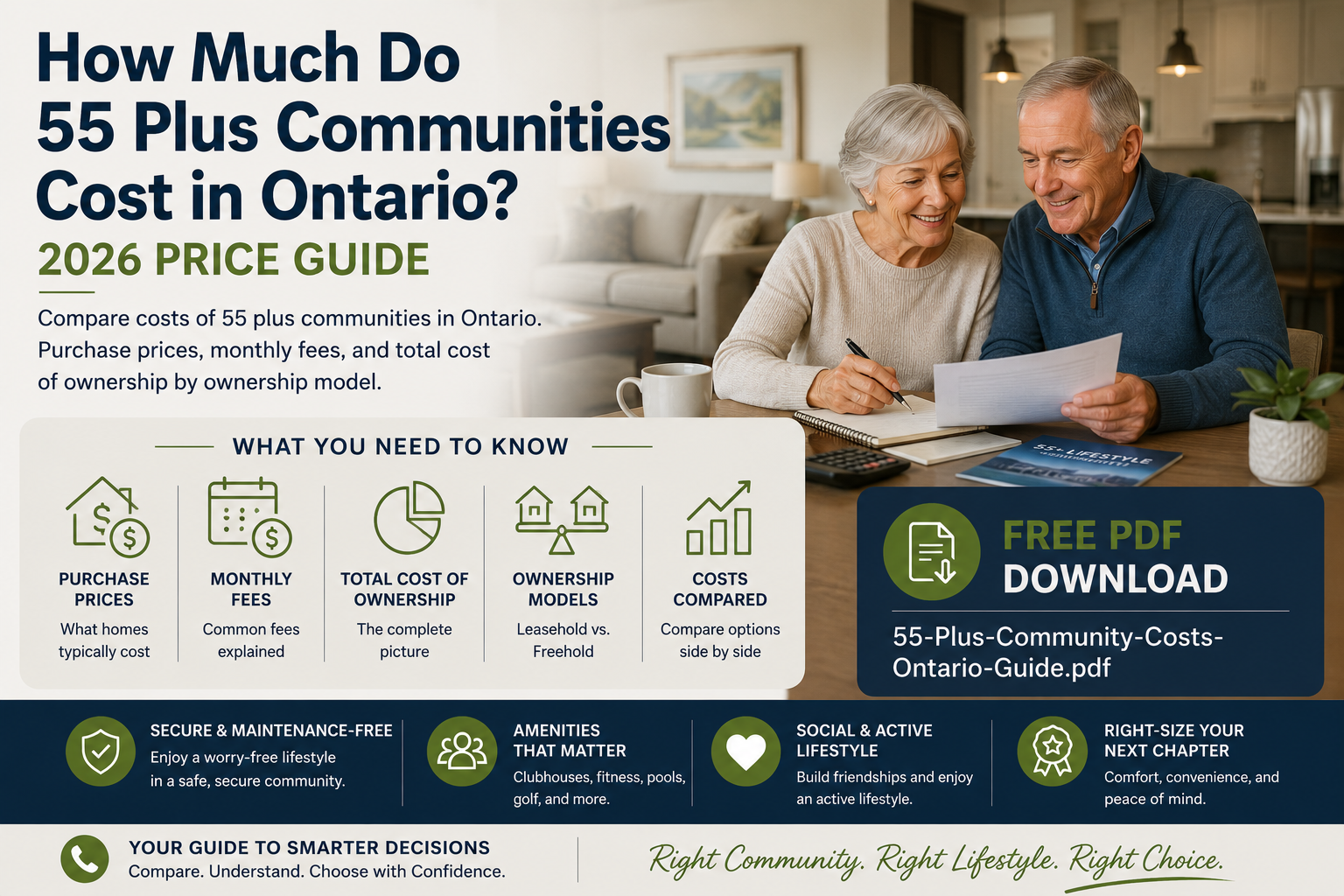
A 55 plus couple sitting at a table in a 55 plus community at 43.989939, -79.784854 going over paperwork.

Click the image above to download your free Ontario 55 Plus Community Cost Guide (PDF).

Watch: A Backstage Tour of the Seller Marketing Plan

If you need to sell your current home before moving to a 55 plus community, this video provides a backstage tour of the seller marketing plan. It shows how Video Narrated VR Animated Online Showings highlight all of a home's key features and benefits online, where buyers shortlist homes they are willing to go see.

10 Questions You Should Ask Before Hiring A REALTOR

Essential questions to ask any agent before listing your home.

Why Didn't My House Sell?

Understanding the common reasons homes fail to sell on the first try.

How to Avoid Legal Mistakes When Selling

Protect yourself from common legal pitfalls during the selling process.

Passing the Building Inspection

How to prepare your home so it passes the buyer's inspection smoothly.

Client Success Stories

Read what downsizers have to say about working with Kevin Flaherty to sell their family homes and navigate community ownership models.

★★★★★
"Kevin and his team made our transition from a large family home to a retirement community seamless. His knowledge of the different ownership models saved us from making a costly mistake."
Peter Haddrell
★★★★★
"We were overwhelmed by the options until Kevin walked us through exactly what to look for. His Video Narrated VR Animated Online Showings let us tour communities without driving all over Ontario."
Melissa R.

Read More Reviews →

Local Expertise: Kevin's Service Areas

If you are selling a home in south-central Ontario to fund your move to a 55 plus community, Kevin Flaherty provides expert listing services across these core regions:

Related 55 Plus Community Guides

Explore other informational guides and resources for finding your ideal 55 plus community in Ontario.

Authoritative Resources

These trusted sources provide additional information about Ontario's retirement community regulations, housing market data, and real estate standards.

Kevin Flaherty, Real Estate Broker

About Kevin Flaherty

Kevin Flaherty is a Real Estate Broker with over 38 years of experience since 1988 and more than $500M sold. Operating out of Orangeville, he specializes in helping clients across south-central Ontario sell their long-held family homes and downsize into adult lifestyle communities. His proprietary Video Narrated VR Animated Online Showings ensure sellers get maximum exposure and top dollar, making the transition to retirement living seamless and financially secure. Call or text toll-free at 1-877-352-4378, or reach Kevin direct at 226-270-6433.

📋
Download Your Free Ontario 55 Plus Community Cost Guide

A complete checklist covering freehold, condo, and land-lease models, amenity evaluations, and worksheets to help you budget for the right Ontario 55 plus community.

Download PDF

Frequently Asked Questions About 55 Plus Community Costs

How much do 55 plus communities cost in Ontario?

Prices vary by ownership model. Land lease homes generally range from $250,000 to $500,000. Condominium homes typically range from $400,000 to $900,000. Freehold homes are the most expensive, often ranging from $500,000 to over $1,200,000.

What are the monthly fees in a 55 plus community?

Monthly fees depend on the community type. Land lease lot fees typically range from $500 to $1,200. Condo fees usually range from $300 to $800. Freehold communities have no mandatory monthly fees, though you pay your own property taxes and maintenance costs.

Are there affordable retirement communities in Ontario?

Yes, affordable options exist, primarily within the land lease model. Because you rent the lot rather than buying the land, the upfront purchase price is significantly lower, making it accessible for downsizers with limited equity.

What is the total cost of owning in a retirement community?

Kevin advises that the total cost of ownership includes your initial purchase price, monthly community fees, property taxes, home insurance, and interior maintenance over a 10-to-15-year period. A cheaper land lease home with high monthly fees can sometimes cost as much over time as a more expensive freehold home.

Are there hidden costs in 55 plus communities?

Potential hidden costs include special assessments in condominium communities, unexpected lot fee increases in land lease communities, and exit fees or administrative charges in life lease communities. It is crucial to review all documents with a lawyer.

What is a life lease community?

A life lease is an arrangement where you purchase the right to occupy a unit for life, typically from a non-profit organization. You pay an upfront sum and a monthly maintenance fee. When you leave, the unit is sold at market value, minus an administrative fee.

Do homes in land lease communities appreciate in value?

Kevin advises that land lease homes can appreciate, but typically at a slower rate than freehold properties. Because you do not own the land, the value is tied to the physical structure and the desirability of the community itself.

Can I get a mortgage for a land lease home?

Yes, but it can be more challenging. Traditional mortgages are often not available because the land isn't owned. Buyers typically need a chattel mortgage or a line of credit, which may require a larger down payment and carry a higher interest rate.

What happens if the land lease expires?

Land leases are typically signed for long terms (e.g., 20 to 99 years). As the expiration approaches, the community operator usually offers a renewal. However, the terms and monthly fees are subject to renegotiation at that time.

Are land lease fees regulated in Ontario?

Yes, land lease communities in Ontario are governed by the Residential Tenancies Act. This means that annual increases to your lot fee are generally capped at the provincial guideline, offering some predictability for your budget.

Are property taxes lower in a land lease community?

Property taxes are often lower in land lease communities because you are only taxed on the assessed value of the structure, not the land. The land tax portion is typically rolled into your monthly lot fee.

What does a condo fee cover in a 55 plus community?

Condo fees typically cover exterior maintenance, landscaping, snow removal, upkeep of shared amenities like the clubhouse or pool, and contributions to the corporation's reserve fund for future repairs.

Can condo fees increase over time?

Yes, condo fees will inevitably increase due to inflation, rising insurance costs, and the need to maintain an adequate reserve fund as the community ages. You must budget for these annual increases.

What is a special assessment?

In condominium communities, if the reserve fund is insufficient to cover a major repair (like replacing all the roofs or repaving the roads), the condo board can levy a special assessment. This requires owners to pay a lump sum.

Do freehold 55 plus communities have monthly fees?

True freehold communities have no mandatory monthly fees. However, some may have an optional neighborhood association fee (often $50 to $100 per year) to cover shared gardens or a small clubhouse.

Is Briar Hill a freehold community?

Yes, mostly. The majority of homes in Briar Hill are freehold or common-element condominium (site condominium) properties where residents own both the home and the land it sits on. Residents pay property taxes plus a monthly maintenance fee that covers snow removal, lawn care, and upkeep of shared amenities. There are also some apartment-style condo units within the community. Unlike land-lease parks, Briar Hill homeowners generally own both the home and the land.

Do 55 plus communities provide medical care?

No. 55 plus communities are designed for independent, active adults. While they offer social and recreational amenities, they do not provide on-site medical care, assisted living services, or nursing staff.

Can I rent out my home in a 55 plus community?

In Kevin's experience, this depends entirely on the ownership model and community bylaws. Freehold properties generally allow rentals, but many condo and land-lease communities strictly prohibit short-term rentals or subletting to maintain community security.

Do I need a real estate agent to buy a new-build home in a 55 plus community?

Kevin strongly advises having your own representation even when buying a new build. The builder's sales representative works for the builder, not you. Your own agent can help negotiate upgrades, review contracts, and ensure your interests are protected.

Can I leave my land lease home to my children?

Yes, you can bequeath the physical home to your heirs. However, if your children wish to live in the home, they must meet the community's age requirements and be approved by the park management to take over the land lease.

What should I look for during a community tour?

Kevin suggests looking beyond the model home. Pay attention to the overall maintenance of the neighbourhood, talk to current residents about the social atmosphere, and carefully inspect the condition of the shared amenities like the clubhouse and pool.

Is it better to buy a resale home or a new build?

In Kevin's experience, resale homes offer established landscaping, known community dynamics, and immediate move-in dates. New builds allow for customization but come with construction timelines, unpaved roads initially, and the stress of managing builder delays.

How do I sell my current home to buy into a 55 plus community?

Kevin recommends coordinating the sale of your current home carefully with your purchase. Using a system like Video Narrated VR Animated Online Showings can help sell your family home efficiently, ensuring you have the equity ready when you find the right community.

How can I find out what my current home is worth?

Before touring communities, it is essential to know your buying power. You can get a free, no-obligation home evaluation from Kevin Flaherty to determine exactly how much equity you have available for your next purchase.
Browse 55 Plus Communities by Region

Click A Region On The Map To View Communities
Tap a region on the map to explore communities.
Illustration of a couple walking hand-in-hand in a scenic outdoor setting with a sunlit background, symbolizing adult lifestyle communities in Ontario, featuring homes and a golf flag, with the text adultcommunities.ca prominently displayed

Kevin Flaherty, Broker

eXp Realty, Brokerage

1-877-352-4378

A HoneyCombHub.ca Web Site Solution

Copyright 2026 . All rights reserved.

Terms of Service/Privacy Policy